


Solar Companies Fresno: Compare Installers

Do not compare installers by system size alone. Ask each company to explain how its design fits your roof, electricity use, equipment, and utility requirements. A low headline figure or broad promise does not show what is included.
When comparing solar companies Fresno homeowners can consider, start with evidence. Confirm each provider serves your address. Request a site-specific design. Compare written details on permits, equipment, warranties, and support.
Use the same questions with each installer. Ask for unclear assumptions in writing. Check whether the proposal names equipment models and explains production assumptions. It should assign permit and utility coordination duties. If roofing work or a battery is included, clarify its scope and purpose.
Separate California-wide experience from verified local references and service availability. Confirm both directly. Commercial properties may need site-specific usage, roof, and engineering assessments. A residential package is not a substitute for a commercial review. Use the checklist below to compare providers.
Request a project-specific estimate
How Fresno Property Owners Can Compare Solar Companies
When evaluating solar companies Fresno property owners may encounter online, verify each proposal. Compare documented work, design assumptions, permit responsibilities, equipment, warranties, and support. A star rating or "best installer" label cannot show project fit.
Check whether each company serves your address and property type. A Fresno search result does not prove a provider can take your project. Ask for recent references or similar work. Confirm the company's license and insurance with current records.
Compare the same project scope in every proposal. Ask what happens if the roof needs repair. Find out how the installer chose system size. Check the equipment list and confirm who handles permits and utility steps. Ask who responds if monitoring or equipment needs attention. If a battery is included, ask which circuits it supports.
This guide focuses on Fresno County permits and other due-diligence questions. It does not rank providers or assume one installer fits every property. Roof, energy use, utility territory, equipment, and project needs shape the design. The U.S. Department of Energy recommends interviewing several installers. Compare their answers and written scope.
How Should Fresno-Area Owners Evaluate Roof and System Design?
A solar proposal should start with the building, not a preset panel count. Ask how roof condition, layout, and remaining life affect the project. If repairs may be needed soon, compare doing them before solar installation with revisiting the roof later. The proposal should name who handles roof work and how mounting details protect it.
Read how to evaluate your roof before solar. Ask which attachment method suits your roof. Find out how the installer will waterproof penetrations and who handles roof warranty questions. The proposal should address these details for your building. A general assurance that the installation is roof-safe is not enough.
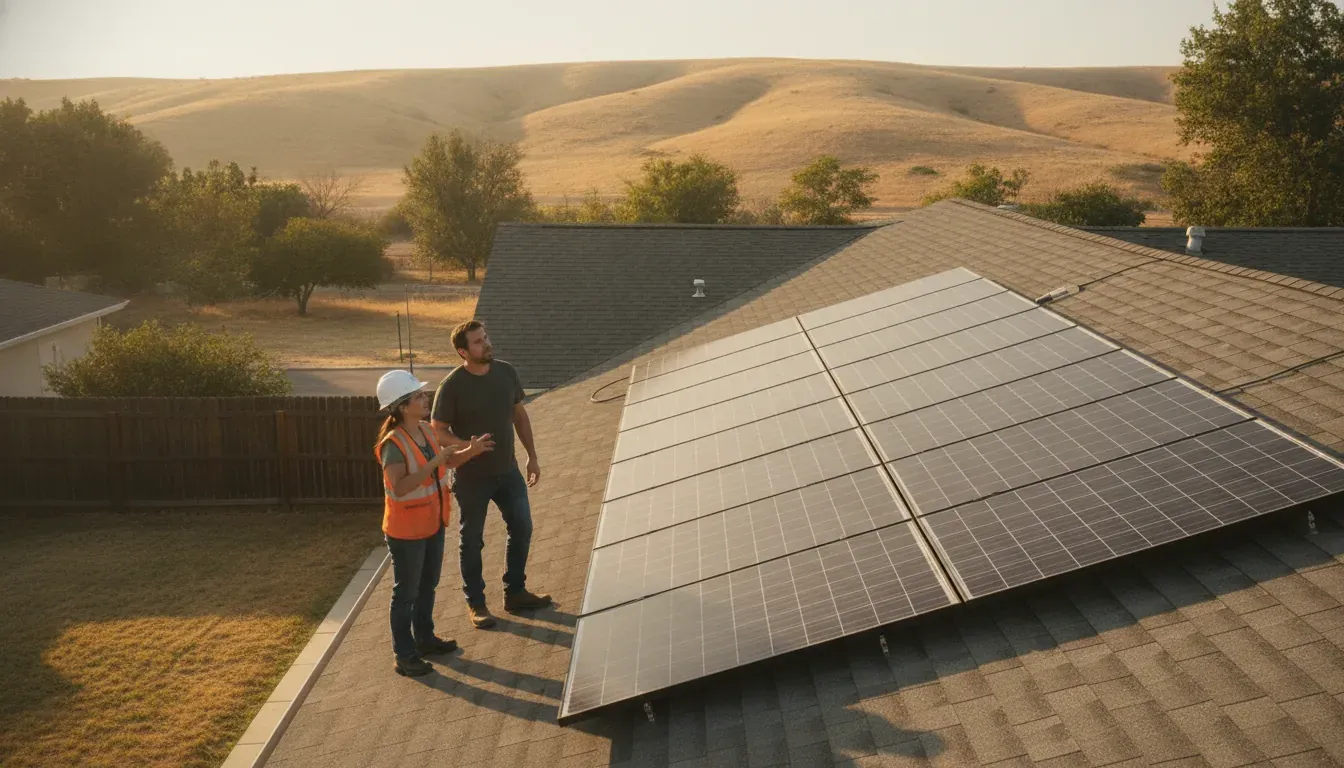
System sizing should reflect electricity use and the owner's goals. For a home, discuss current use, likely changes such as an electric vehicle, and backup needs. A business assessment may consider operating schedules, equipment loads, and demand patterns. Tie battery design to priority backup loads. Do not assume it will power every circuit.
Ask what was inspected and what still needs confirmation. Roof structure, electrical service, panel location, shade, and roof area can affect design. A remote review can inform an initial proposal. Ask if an on-site structural, roof, and electrical assessment is needed before final design. The solar system planning guide offers more questions on matching a system to use and roof conditions.
Commercial buildings can have different structural and engineering needs from homes. Roof construction, facility loads, and mounting methods may vary. Compare the assessment scope and ask who handles engineering and coordination. AMECO's commercial project information describes its offerings. Each property still needs its own evaluation.
Confirm that the installer currently serves your Fresno-area address. A California-wide presence alone does not establish local availability. The proposal should state assumptions, open site questions, roof responsibilities, and design decisions that may change after inspection.
What Should Installers Handle in Fresno Solar Permitting?
Before comparing proposals, identify the authority that reviews the property. Fresno County requirements do not apply to every address in the same way. A property inside a city may follow city rules. An unincorporated property may fall under county jurisdiction. Ask which authority serves your site and which permit applies. Avoid a vague claim that the contractor "handles permits."
Fresno County uses SolarAPP+ for eligible roof-mounted systems in its jurisdiction. Its confirmation is not the building permit. The permit application is still required. Other solar applications use a different permit subtype. Battery-only and panel-upgrade-only applications use a construction permit. See the County's SolarAPP+ permit details. Confirm requirements for your property with its authority.
Ask the installer to separate building permits, electrical or structural reviews, inspections, and utility interconnection. Interconnection is a utility approval, not a local permit. The U.S. Department of Energy's installer-selection guidance recommends comparing several installers.
Get responsibilities in writing. Ask each company:
| Compare | Ask the installer | What to verify |
|---|---|---|
| Site and roof | What roof, shade, and electrical checks are complete? | Written assumptions and any open inspections |
| Permits | Which authority serves the address, and who submits? | Permit application, inspection, and utility roles |
| Equipment | Which exact models and monitoring system are proposed? | Itemized equipment list and substitution process |
| Warranty and service | Who covers equipment, workmanship, and roof penetrations? | Written terms, exclusions, and support contact |
- Who confirms which city or county authority serves the address?
- Will your team submit and track permits, and provide the permit and inspection results?
- For a battery or panel upgrade, which permit pathway applies?
- Who submits utility interconnection and confirms permission to operate?
- Which approvals and inspections must be done before activation?
Compare actual answers, not broad promises. A clear proposal names who submits documents and handles revisions. Learn about the professional solar installation process. Compare each provider's scope with your property's needs.
How to Compare Solar Equipment and Proposals
A proposal should show what the system includes and how the estimate was built. Ask each installer to name every major component model. Avoid labels such as "premium panels" or "high-efficiency inverter." The equipment list should cover modules, inverters, monitoring, and any battery. Ask how substitutions are approved.
Compare system size and design assumptions. Consider capacity alongside electricity use and energy goals. Do not treat size alone as a measure of value. Check which usage data and time period the proposal uses. Ask how production was estimated. If proposals differ, ask which inputs explain the gap.
Site assumptions matter in Fresno. Ask whether design reflects roof direction, shade, usable area, and roof or electrical limits. The proposal should state its assumptions and explain what happens if a site visit changes them. If production estimates use degradation assumptions, ask for the source. Do not compare estimates based on different assumptions as equals.
Clarify monitoring before signing. Ask what the platform measures and how you access it. Find out whom to contact if data is missing or an alert appears. Confirm required hardware and software are included. Check for written support terms. Monitoring shows activity, but does not guarantee production or response times.
Compare written scope, not just equipment. Check whether design, permits, utility coordination, installation, inspections, activation, and handoff are included. Ask if roof work or electrical upgrades are excluded or need assessment. Find out who owns each task and how changes are handled. Warranty documents should name responsible parties and explain coverage for equipment, workmanship, and roof penetrations. Terms vary by project.
For a clearer starting point, use this guide to plan a solar system for your home. Then review AMECO solar installation services. An itemized proposal makes it easier to ask informed questions and compare options on the same basis.
How Do Warranties, Batteries, and Ongoing Support Compare?
A proposal can use "warranty" for several agreements. Ask for the documents. Compare who is responsible, what is covered, and how to request service. Terms depend on equipment, installation scope, and exclusions.
Separate equipment coverage from installation coverage
Manufacturer warranties cover specified equipment, such as modules, inverters, or batteries. Terms differ by model. Check the covered component, term, conditions, and claim process. Ask if the installer helps with manufacturer claims or if you contact the manufacturer directly.
Workmanship coverage differs from equipment coverage. It addresses the installer's work, not every equipment failure. Ask how the agreement handles roof penetrations and leaks. Roofing material, roofing workmanship, and solar installation coverage may be separate. Review roofing warranty types. Get the responsible party and claim process in writing.
Match battery design to the outage plan
Battery proposals should start with your outage needs. Name priority loads, such as refrigeration, lights, or key equipment. Ask which circuits the proposed system supports. Design depends on loads, electrical setup, battery, and goals. A battery does not automatically power the whole property.
Compare battery model and configuration. Ask what happens when stored energy runs out. Ask how the system works with solar during an outage. Review assumptions about energy use. Compare battery storage options by intended use, not package name.
Clarify monitoring and support ownership
Monitoring can show system status, but an app is not ongoing service. Ask who reviews alerts. Clarify whether you or the provider should notice a problem and start troubleshooting. Confirm whom to contact after installation. Ask if support helps diagnose production or battery issues, and which problems go to a manufacturer or utility. Get responsibilities, fees, and exclusions in writing. This is more useful than a broad promise to "be there" after the project is complete.
A Practical Way to Shortlist Solar Companies Fresno
Use the same request with each provider. Ask about local experience and distinguish evidence from marketing language. A company may serve a wide region without a nearby office or work on your roof type.
- Confirm project fit. Ask whether the company serves your address and handles projects like yours. Request references. Confirm licensing and insurance with current records. The DOE recommends checking installer credentials and experience.
- Request a site-specific design. Ask how size relates to your energy use, roof condition, shade, electrical setup, and future plans. For commercial properties, request the engineering assumptions.
- Make scope clear. Ask who inspects the roof, handles repairs, installs mounts, gets permits, arranges inspections, and coordinates utility interconnection. Ask what is excluded and what could change the scope.
- Compare equipment and documents. Request models for panels, inverters, monitoring, and batteries. Ask for warranty terms and who covers workmanship and roof penetrations.
- Clarify the handoff. Ask who activates the system, explains monitoring, responds to service requests, and describes battery limits. Get the support process in writing.
Use this quick checklist before signing:
- Are assumptions and exclusions stated in a proposal?
- Can the company document its license, insurance, and relevant references?
- Are permit and utility responsibilities assigned?
- Do warranty papers identify the covered component, term, and claim contact?
- Does the battery proposal name the priority loads rather than promise undefined whole-property backup?
AMECO outlines its history and services on its company background page. Confirm current service for your address. Review a project-specific scope rather than infer coverage from general company information.
Request a project-specific estimate
Frequently Asked Questions
Who is the most reputable solar company?
No single company is right for every property owner. Judge reputation with current, verifiable information. Check project experience, license and insurance, system design, permit duties, warranty documents, references, and support. Reviews can suggest questions, but do not replace checking the scope and terms.
Is solar still worth it in California?
Solar value depends on energy use, roof condition, utility rules, equipment, project cost, and incentive eligibility. Ask installers to show their assumptions. Verify utility and incentive details for your situation. Do not rely on a generic savings promise.
How much does it cost to put solar panels on a 2,000-square-foot house?
Floor area alone cannot determine system size or cost. Providers must consider electricity use, roof layout and condition, shading, electrical equipment, utility territory, design, and storage. Compare proposals based on the same usage data. Ask which items could change the scope.
What is the 20% rule for solar panels?
The phrase "20% rule" does not identify a universal solar requirement. Ask who uses it to name the code, utility rule, contract term, or design assumption. Request a source. Requirements depend on the project and jurisdiction. Confirm details with the permitting authority, utility, or qualified installer. Do not treat an unexplained percentage as a standard.
For local permitting, consult the applicable county or city building department and ask each installer to explain the process for your address.
Compare Your Project With Clear Scope and Assumptions
A sound solar decision starts with a clear picture of the roof, energy use, design, permits, and support. For a Fresno-area property, confirm an installer serves your address. Request a written assessment of its assumptions and responsibilities. AMECO Solar & Roofing has provided California solar and roofing services since 1974. Its approach can coordinate roof and solar work when appropriate. Confirm project fit and availability for your property.
Ask AMECO about a project-specific estimate and confirm service availability for your address.


.svg)
