


Commercial Solar Battery Storage for California Businesses

For many California businesses, the value of adding a battery is less about storing solar in the abstract and more about controlling when energy is available. A manufacturing site, retail property, office, or warehouse may have different load peaks, operating hours, outage concerns, and utility rate structures. The right project starts with the facility's actual data and priorities.
Request a project estimate for your commercial solar and storage needs.
Commercial solar battery storage combines solar generation with a battery energy storage system that can shift energy for later use. It can help manage selected demand peaks and support critical loads during an outage. Whether it is a sound investment depends on the site's load profile, tariff, desired resilience, system design, controls, and lifecycle costs, not on a universal price or payback.
A practical evaluation should therefore connect technical capabilities to business needs. Before comparing equipment, it helps to understand how the system works and which operating goals it can realistically support.
What Is Commercial Solar Battery Storage?
Commercial solar battery storage combines a battery energy storage system (BESS) with a business's solar photovoltaic (PV) system and electrical loads. Instead of using solar generation only when the array is producing, the battery can store electrical energy for later use. The system may also be configured to support selected critical loads when the grid is unavailable, depending on the equipment, controls, interconnection, and the facility's operating requirements.
The terms power capacity and energy capacity describe different parts of the system. Power capacity, measured in kilowatts (kW), indicates how much electricity the battery can deliver or absorb at one time. Energy capacity, measured in kilowatt-hours (kWh), indicates how much energy it can hold. A business may need substantial power for a short, high-demand event, greater energy capacity for a longer operating period, or a design that balances both. The right combination depends on the loads the system is intended to serve.
How does a BESS work with commercial solar?
Solar integration connects the PV array, battery, building loads, and utility service through equipment and operating controls. During periods when solar production exceeds the facility's immediate use, the system may direct some of that energy into the battery. Later, the battery may discharge when the business needs energy, including outside daylight hours. Actual operation depends on the system design and the rules established for the property.
For a California business, the design conversation should start with the loads that matter most. Critical loads might include selected refrigeration, communications, security, production, or life-safety equipment, but the appropriate circuits must be identified during project planning. A battery is not automatically a whole-building backup system. Its output, energy capacity, electrical configuration, and controls determine what it can support and for how long.
Why do controls matter?
Controls coordinate battery operation with solar production and connected building loads. The U.S. Department of Energy's commercial building technology guide describes battery storage, building controls, and load flexibility as related tools for managing energy use. That illustrates why storage is more than a battery cabinet: the system must be evaluated as part of the facility's electrical and operational environment.
Explore AMECO's battery backup systems and storage options, then discuss the property's solar array, load priorities, and operating goals with a qualified project team.
Which Business Problems Can Storage Help Solve?
Commercial battery storage is most useful when it is matched to a specific operating problem. A battery can store available solar energy, discharge when the facility needs power later, and coordinate with site controls. The right use case depends on the building's load profile, utility tariff, critical equipment, and operating schedule. A storage system should be evaluated as part of the property's broader energy plan, not as a standalone product.
Managing peaks and shifting energy use
Many commercial facilities experience their highest demand when solar production is declining or has ended. Solar generation may not align with a building's peak load, particularly when demand moves into the afternoon or evening. Storage can discharge during those periods and can also buffer a temporary drop in solar output caused by passing clouds. These capabilities may help a facility manage demand, but the result depends on the tariff's demand-charge rules, peak windows, and the battery's power and energy capacity. Research from Lawrence Berkeley National Laboratory explains why load shape and peak timing matter when evaluating storage.
For a California business, useful questions include:
- When do the facility's monthly demand peaks occur, and how long do they last?
- Does the utility measure demand during a defined peak period or across the billing period?
- Can the system reserve enough capacity for the most important operating windows?
- What happens if the site load changes because of new equipment, production shifts, or electric vehicle charging?
Storage can also increase solar self-consumption by moving some daytime generation to later use. That may be relevant for facilities whose operating schedule does not match the hours of strongest solar production. Review solar system design and project process alongside storage planning so the PV array, battery, controls, and site load are evaluated together.
Supporting selected critical loads during an outage
Backup planning starts with identifying what the business must keep operating, rather than assuming the entire building can remain energized. Critical loads might include refrigeration, networking, security, life-safety equipment, selected production controls, or lighting. The required battery power, usable energy, transfer equipment, and recharge strategy all depend on those loads and the expected operating conditions. Storage can improve resilience for selected circuits, but it does not guarantee uninterrupted service or a universal backup duration.
Preparing for more coordinated controls
Modern energy-management systems can use load data, solar forecasts, battery state of charge, and operating priorities to adjust dispatch. The DOE Connected Communities project description shows how batteries, solar, and flexible building loads can be coordinated, although any program eligibility and value must be confirmed for the specific site. AMECO's commercial solar solutions for businesses can be a starting point for discussing how these goals fit a facility's design.
Request a project estimate to review your load profile, solar opportunity, critical circuits, and control objectives before selecting a system configuration.
How Do You Evaluate the Economics of a Commercial System?
The financial case for commercial solar battery storage begins with the utility tariff, not a generic battery price or a promised payback period. Behind-the-meter storage savings are intrinsically linked to retail rate design, so the same equipment can produce different results at two facilities. A useful analysis should model the property's actual interval load data, solar production, operating schedule, and business priorities.
Start with the tariff and the load shape
Review the complete tariff. Check energy charges, demand charges, and time-of-use (TOU) periods. Also check critical-peak pricing (CPP), real-time pricing (RTP), and net-billing treatment for exported solar. Demand-charge savings depend on the charge rate and whether demand is coincident with a defined peak period. The peak window's duration, the billing-demand averaging interval, seasonal rates, and any demand ratchet also matter. Common averaging intervals include 15, 30, and 60 minutes. A ratchet can establish a minimum billing demand based on a portion of the prior year's maximum.
Then test the tariff against interval data rather than monthly totals. A peaky or variable load, and the timing of its peaks, can materially change the value of storage. Dispatch assumptions should state when the battery charges, when it discharges, how much reserve is held for outages, and how controls respond to forecasts. Longer-duration systems may create more energy-arbitrage value than demand-charge value in some cases, but that outcome is not universal.
Commercial storage economics: key inputs.| Driver. | Check. | Purpose. |
|---|---|---|
| Demand charges. | Rate, peak window, interval, seasonality, ratchets. | Tests billed demand reduction. |
| Energy charges. | TOU, CPP, RTP, net billing, price differences. | Tests energy-shifting value. |
| Lifecycle costs. | Capacity, power, degradation, maintenance, controls, replacements. | Tests long-term model quality. |
Model the full lifecycle, not just the first-year bill
A responsible model includes installed system and interconnection costs. It also includes financing or capital assumptions, software, controls, maintenance, degradation, warranty limits, and future component replacement.
Compare operating cases, such as solar alone, storage alone, and solar plus storage, using documented dispatch rules. State the assumptions for demand-charge management, energy shifting, outage reserve, controls, and lifecycle costs. Use current utility and program information for a specific project.
For context, compare the storage model with the broader commercial project cost factors and review commercial tax credit details separately. Universal price, savings, or payback claims are invalid because tariffs, load profiles, system sizing, controls, degradation, and site conditions differ. Use a site-specific lifecycle analysis instead.
What Should a California Business Ask Before Installation?
A well-designed project starts with questions that connect the battery to the facility's actual operations. Use this checklist with your installer, utility, engineer, and facilities team. The goal is not to select equipment from a brochure. It is to confirm that the proposed commercial solar battery storage system fits the building, electrical service, operating priorities, and approval requirements.
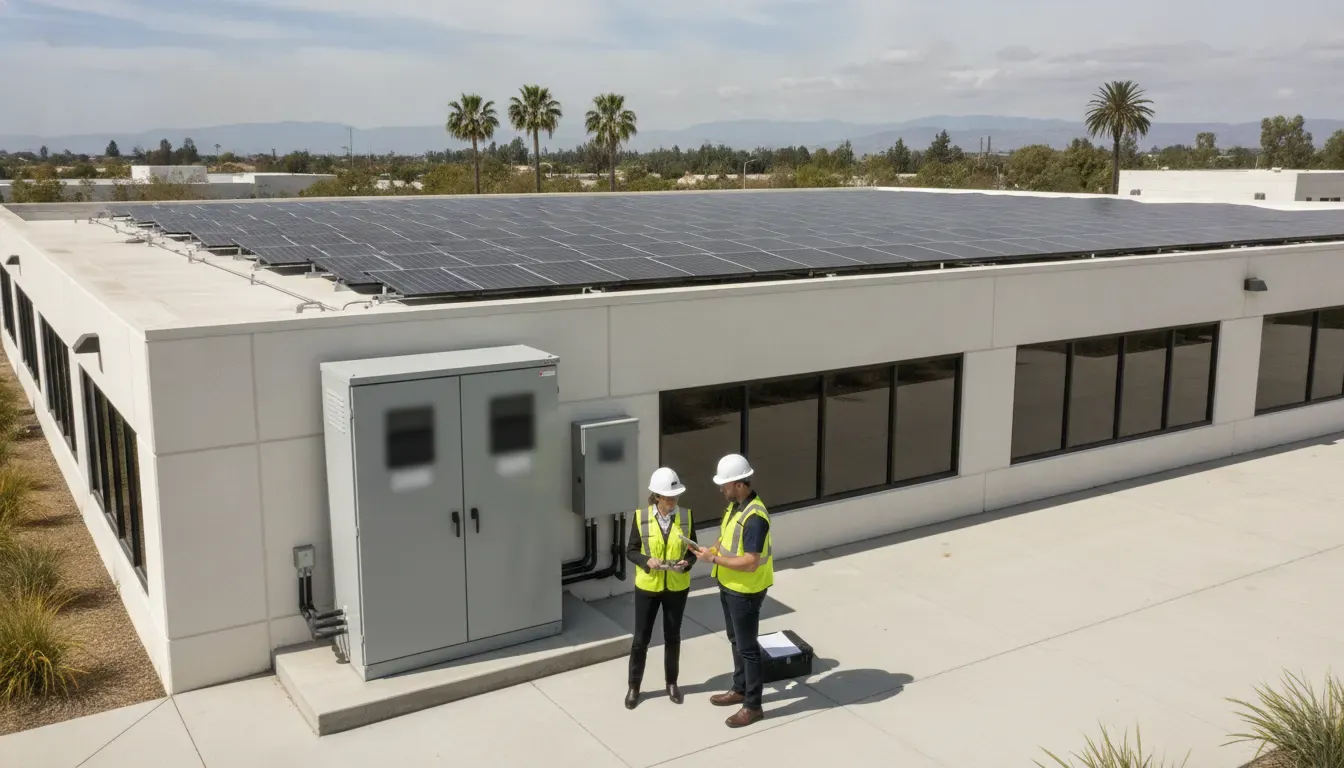
- Can you model the facility using interval-load data? Ask which utility data will be used, how the billing-demand interval is measured, and whether the analysis covers seasonal operations, production schedules, weekends, and unusual peaks. A monthly total is not enough to show when the building uses power.
- Which loads must remain available during an outage? Identify critical circuits, their starting loads, and how long they may need support. Separate life-safety, refrigeration, communications, security, production, and convenience loads instead of treating the entire building as one backup circuit.
- Are power and energy sized separately? Power, measured in kW, describes how much the system can deliver at once. Energy, measured in kWh, describes how long it can deliver under a given load. Ask the designer to show both assumptions and explain how battery discharge limits affect the operating plan.
- What controls will manage solar, loads, and the battery? Confirm the dispatch strategy, monitoring, forecasting, manual override, outage detection, and testing plan. The DOE's battery storage implementation materials describe energy shifting, peak shaving, backup functionality, and control strategies as distinct applications.
- What will interconnection require? Ask who coordinates with the utility, what changes may be needed at the service equipment, and how export limits, protection settings, and anti-islanding functions will be verified.
- Is the roof and electrical infrastructure ready? Review roof condition, structural capacity, equipment clearances, switchgear, transformers, conduits, and available space before finalizing the layout. AMECO's project approach and support should account for these site conditions during planning.
- Which permits and safety standards apply? Confirm the permitting path and responsibility for fire, building, and electrical approvals. The DOE battery storage materials note that safety, controls, and operating requirements must be considered for a complete system. Also ask how the design addresses thermal-runaway detection, separation, response, and emergency access.
- What happens after installation? Get warranty terms, degradation assumptions, maintenance intervals, software-support conditions, response procedures, and commissioning deliverables in writing. Commissioning should verify controls, alarms, operating modes, backup transitions, and performance against the approved design, not simply confirm that the equipment powers on.
Request a project estimate for your commercial solar and storage needs.
Bring these answers into the economic review and the final scope before moving to the frequently asked questions.
FAQs: Commercial Solar Battery Storage
What is a commercial battery storage system?
A commercial battery storage system stores electricity for use at a later time. When paired with solar, it can capture excess daytime production and discharge it when the facility needs more power. Depending on the design, storage may also support selected critical loads during an outage. The battery, inverter, controls, electrical equipment, and site connections must be evaluated as one system.
Is battery storage worth adding to a commercial solar system?
It can be, but the answer depends on the facility's load profile, utility tariff, demand charges, operating schedule, outage priorities, and project goals. Storage may help shift solar energy, manage certain peak periods, or support selected operations during an outage. A useful evaluation uses interval utility data and models dispatch assumptions rather than relying on a universal savings or payback estimate.
How much does a commercial battery cost?
There is no reliable universal price for a commercial system. Cost depends on the battery's power and energy capacity, electrical upgrades, controls, interconnection requirements, site conditions, permitting, and the loads the system is expected to serve. Ask for an itemized proposal that separates equipment, installation, design, permitting, commissioning, maintenance, and expected replacement considerations.
How much storage does a solar battery have?
Storage is described by both power capacity and energy capacity. Power capacity indicates how much electricity the system can deliver at one time, while energy capacity indicates how much electricity it can store. The appropriate size depends on the facility's load shape, critical circuits, desired operating duration, solar production, and control strategy. More capacity is not automatically the best fit.
What is the best solar battery storage system?
The best system is one that matches the property's electrical conditions, operating goals, safety requirements, tariff, and budget. Compare usable capacity, output, controls, monitoring, integration with solar, service support, warranty terms, and expansion options. A qualified project team should also explain how the proposed system will be permitted, commissioned, maintained, and tested for the business's intended use.
Plan Your Commercial Solar and Storage Project
A project estimate can help your team connect storage goals with your facility's load profile, operating priorities, and site conditions. AMECO can help you define the questions and information needed for a more informed commercial solar and battery storage plan. To discuss your needs, request a project estimate.


