


Commercial Solar Companies in California: Proposal Guide
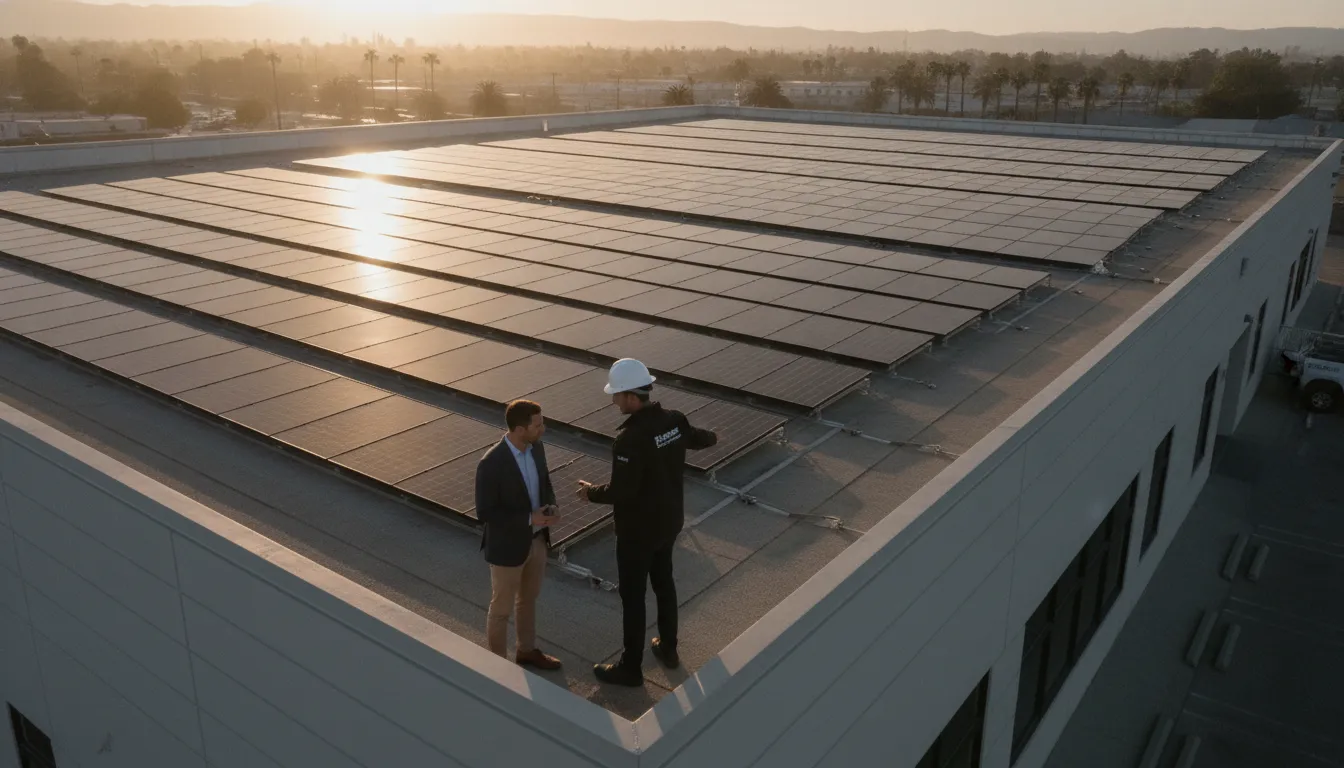
When comparing commercial solar companies in California, look beyond a system size and a projected savings figure. A proposal is a map of who will design the project, procure equipment, manage approvals, protect the roof, and support the system after it begins operating. Comparing those responsibilities before you compare prices can reveal gaps that are easy to miss in a polished sales presentation.
The strongest way to evaluate commercial solar companies in california is to give each bidder the same project information. Then compare engineering assumptions, contracting entities, roof and electrical scope, equipment, utility responsibilities, service terms, and financial modeling side by side.
Start by confirming what each company actually means by its role. An EPC contractor typically handles engineering, procurement, and construction under one contract, but a project may also involve subcontractors. California work can involve C-46 solar and C-10 electrical classifications, while roof repair or replacement falls under separate roofing or general building work. Ask which legal entity is responsible for each obligation, then use that answer to build a proposal comparison that holds up under due diligence.
How Should You Compare Commercial Solar Companies in California?
A proposal deserves more scrutiny than a headline ranking. The right comparison asks whether each company has documented the engineering assumptions, legal responsibilities, roof scope, utility work, and long-term service obligations behind its offer. Two commercial solar companies in California may describe similar systems while assigning critical work to different entities or subcontractors.
Start by naming the delivery role
EPC means engineering, procurement, and construction. In an EPC arrangement, one party typically designs the system, procures equipment, and builds the project under one contract. That label alone does not tell you who will perform every task. Ask whether the bidder is the EPC, a project developer, a sales organization, or a general contractor coordinating separate trades.
Then identify the exact legal entity responsible for engineering, construction, warranties, and ongoing service. Those responsibilities may not sit with the same company. Your proposal and contract should name each party, explain any subcontracting, and state who handles a problem after commissioning. This is a more useful due-diligence question than relying on a ranking, badge, or broad claim about experience. For additional credential checks, see AMECO's guide to verify solar company credentials.
Verify California licenses and roofing scope
California solar and electrical work can involve CSLB C-46 Solar and C-10 Electrical classifications. Confirm the license information for the entity performing the physical work through the California Contractors State License Board. A rooftop solar contractor may act as the EPC or subcontractor, while roof repair or replacement is separate work under an applicable roofing or general building license.
That distinction matters when your facility needs roof maintenance, repair, replacement, or solar coordination. Ask which company owns the roof assessment, penetrations, waterproofing, and corrective work, and request exclusions in writing. AMECO's commercial solar services provide one example of how to evaluate solar scope alongside a building's broader needs. For a second perspective on experience and specialization, read how to evaluate a solar installer's experience.
Start With a Shared Project Brief and Clear Engineering Assumptions
Before asking commercial solar companies in California for proposals, give each one the same project information. A shared brief makes differences easier to evaluate because a larger system, higher production estimate, or lower apparent price may simply reflect different assumptions. Start with 12 months of interval energy data, the applicable tariff name, a current roof or site plan, electrical service size, and the ownership structure you want evaluated. This approach is especially useful when comparing commercial solar design and installation options.
Give Every Bidder the Same Starting Data
Your brief should identify the facility, operating schedule, planned changes in consumption, available roof or ground area, known shading, and any roof work already under consideration. Include utility bills and interval data in the same format for every bidder. If the building may add equipment or expand operations, state that clearly. AMECO describes custom system design around current energy use and forecasted consumption. So a proposal should explain how those inputs shape system sizing rather than treating a standard package as a final design.
- 12 months of utility bills and interval energy data
- Current roof or site plans, electrical service details, and shading information
- Operating schedules, planned load changes, and roof work under consideration
- Ownership or financing preferences to model consistently
Require Assumptions Alongside the Recommendation
Ask each company to show how it moved from your data to its proposed DC system size and annual energy estimate. Production should be accompanied by the assumptions behind it, including the site layout and any material constraints. You should also understand what is included in permitting, utility coordination, equipment procurement, construction, and post-installation service. A serious proposal names the contracting entity and lists equipment model numbers, permitting scope, interconnection responsibility, warranties, and a service plan.
Commercial solar bid inputs and required disclosures
| Bid area | Provide to every bidder | Require in every proposal | Why it matters |
|---|---|---|---|
| Energy and tariff. | Interval data, bills, tariff name, operating schedule. | Annual production and bill-model assumptions. | Shows whether estimates use comparable load and rate inputs. |
| Site and electrical. | Roof or site plan, service size, shading, planned changes. | DC system size, layout basis, and electrical scope. | Reveals design constraints and possible exclusions. |
| Commercial terms. | Ownership or financing preference. | Line-item scope, contracting entity, and disclosed price basis. | Separates unlike offers and identifies who is accountable. |
| Delivery and support. | Known permitting or roof conditions. | Permitting scope, interconnection owner, warranties, service plan. | Clarifies responsibilities after contract signing. |
Use the same discipline when reviewing commercial solar installation process details and solar options for California businesses. AMECO presents commercial systems as tailored to business power requirements. That makes the quality of the shared inputs, and the transparency of each proposal's assumptions, more important than comparing headline system size alone.
Does the Proposal Match Your Roof and Electrical Scope?
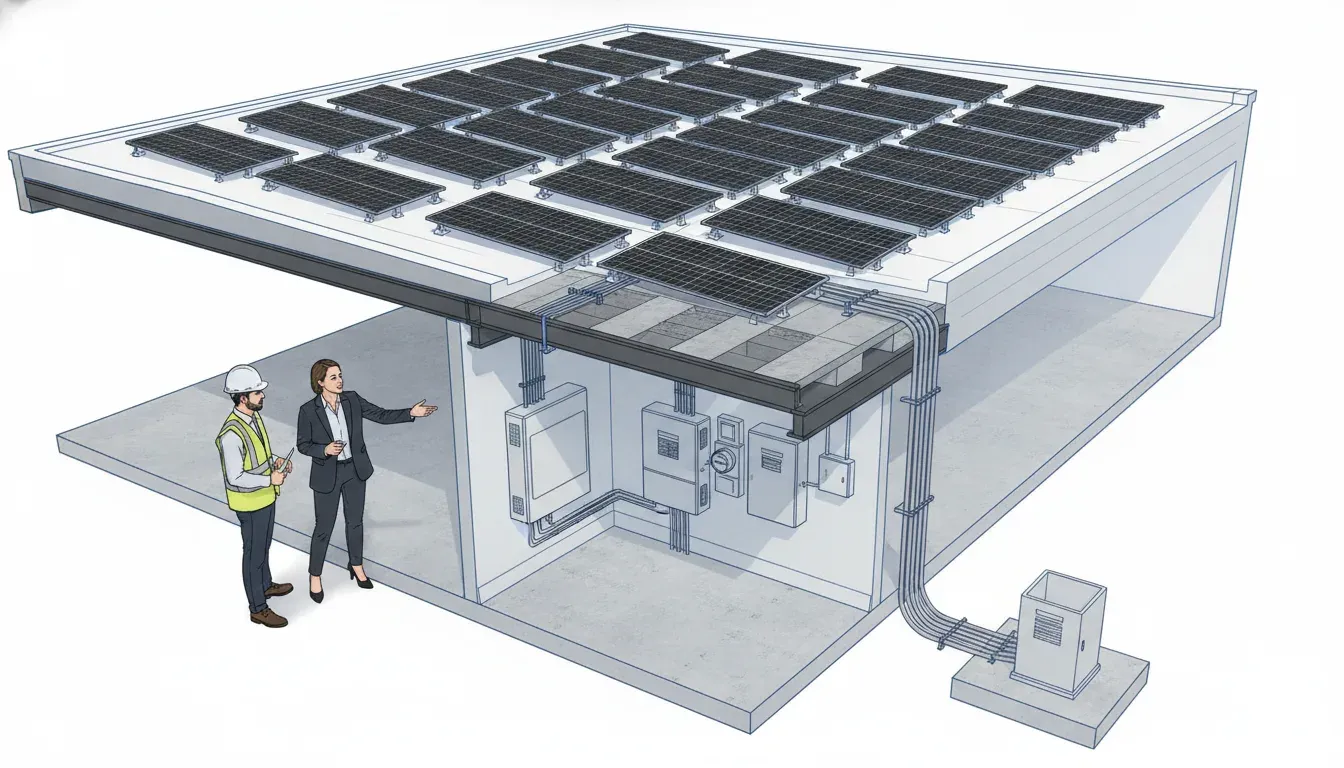
A commercial solar proposal is only as complete as its assumptions about the building beneath the array. Before comparing system size or production, confirm that the proposal addresses roof readiness, attachment details, structural review, electrical work, and the responsibilities that connect those pieces.
Check roof condition and attachment details
Ask whether the roof is expected to remain in service for the planned project and what inspection supports that conclusion. The proposal should identify the roof type, repair or replacement needs, mounting method, attachment locations, and responsibility for restoring affected surfaces. Roof-mounted supports should follow manufacturer instructions, while every penetration should be flashed with specified materials to create a weather-tight, leak-resistant assembly. These are not cosmetic details. They affect maintenance access, water management, and the risk of disputes after installation. NREL's roof-mounted equipment specification describes the expected result as watertight, safe, wind-resistant, and compliant work: review the underlying installation requirements.
If a proposal excludes roof repairs, membrane work, structural reinforcement, or removal and replacement, ask for a written allowance or a separate bid. AMECO's commercial roofing scope includes flat-roof maintenance, repair, replacement, and installation, which can be relevant when solar work must be coordinated with roof work. That company capability is not a reason to skip independent due diligence. It is a reason to ask exactly where roofing and solar responsibilities begin and end.
Separate electrical scope from installation shorthand
Look for the service voltage, main distribution equipment, point of interconnection, conduit routes, disconnects, metering changes, and any panel or transformer work. The proposal should state whether engineering, structural review, permits, inspections, and utility coordination are included or excluded. It should also identify who supplies and installs equipment, and where inverters and disconnects will be placed. They should be safe and accessible for operation and service.
Confirm sequencing and exclusions
Ask what happens first if the roof needs work, whether roof sign-off precedes mounting, and who documents penetrations before closeout. Request a line-item exclusions list covering crane access, roof restoration, electrical upgrades, trenching, hazardous materials, and site repairs where applicable. A clear sequence reduces change-order risk and makes it easier to compare commercial solar installation scope across proposals. The strongest proposals connect the roof, structure, electrical system, and closeout process rather than treating each as an unpriced assumption.
What Equipment, Interconnection, and Utility Work Is Included?
A proposal is easier to compare when it names the equipment and assigns responsibility for the work between your site, the local permitting authority, and the electric utility. Ask for model numbers for the modules, inverters, racking, monitoring equipment, disconnects, and any switchgear. The proposal should also state the system's design assumptions and identify who handles permitting, inspections, and utility coordination.
Are the equipment and placement details specific?
Look beyond a generic equipment brand. The inverter and disconnect locations affect access, safety, conduit routing, maintenance, and coordination with your existing electrical service. NREL guidance calls for inverters and disconnects to be installed in safe, accessible locations, with panels installed on their mounting structures according to manufacturer instructions. See the NREL installation specification for the underlying requirements.
Request a preliminary equipment layout or single-line diagram showing where major components connect. Confirm what is included at the point of interconnection, such as switchgear, protection equipment, utility-required metering, trenching, or service modifications. If the proposal excludes a needed upgrade, the headline price may not represent the complete project scope.
Who owns permitting and utility interconnection?
Local government approval and utility interconnection approval are separate processes. The U.S. Department of Energy explains that a solar installation needs local approval and separate utility approval before it can operate on the grid. California utilities may differ in when they require an interconnection application during local permit review. So a responsible bidder should identify the applicable utility process early rather than treating it as an afterthought. Utility inspections are also separate from local permitting inspections. Review the DOE solar permitting guidebook for this distinction.
Ask the proposal to name the party responsible for application preparation, utility correspondence, plan revisions, inspections, and permission to operate, or PTO. AMECO identifies permitting, inspection coordination, and utility interconnection among its solar project-delivery elements. Those responsibilities should still be confirmed in your contract and project documents, not assumed from a sales conversation. You can review the company's project approach and commercial solar design and installation scope as part of that evaluation.
Calculate Your Project with the site, utility, and scope details that shape a commercial proposal.
What happens if the utility requires upgrades?
Interconnection documents should identify the project site, parties, export terms, any caps or restrictions, required upgrades, and the conditions for PTO. Ask who pays for utility-directed work and how design changes are handled. Do not accept a universal PTO promise. The utility may require an application review, site inspection, or system modification before granting permission to operate, and the outcome depends on the specific service and utility requirements.
Who Owns Operations, Monitoring, and Warranties After PTO?
Permission to operate is a milestone, not the end of your vendor relationship. Before signing, identify who remains responsible for monitoring, service coordination, warranty claims, and documentation once the system is producing energy. A serious commercial proposal should state its service plan and warranties alongside equipment models, production assumptions, permitting scope, and the party handling interconnection. AMECO's project approach can help you see how responsibilities are organized before construction begins.
Name the responsible legal entity
Do not rely on a brand name alone. Ask which exact legal entity is responsible for engineering, construction, equipment warranties, workmanship, and ongoing service, and whether those responsibilities sit with one company or are divided among an EPC, subcontractors, manufacturers, and a separate operations provider. Those distinctions affect where you send a service request and who must respond when a problem crosses trade boundaries.
Put each party's role in the contract and handoff package. The contracting entity, installation contractor, roofing contractor, equipment manufacturers, and monitoring provider should be identifiable. If roofing work is part of the project, clarify whether roof workmanship and solar installation are covered separately. AMECO's California solar and roofing background provides useful company context, but your proposal should still define the obligations for your specific property.
Confirm monitoring access and service response
Request administrator-level monitoring access, the platform name, alert responsibilities, and the process for diagnosing underproduction or equipment faults. Ask who reviews alerts, how you open a ticket, what information is required, and whether the service plan includes periodic reporting. The system should also leave operations staff with practical access to inverters and disconnects. NREL guidance calls for these components to be installed in safe, accessible locations, supporting both routine inspection and emergency response: NREL rooftop PV installation specifications.
Document warranty boundaries and handoff records
Separate manufacturer equipment warranties from installer workmanship coverage, roof or waterproofing obligations, and exclusions. Ask what events can void coverage, who submits a claim, and whether labor, shipping, removal, or reinstallation is included. Do not accept a single undifferentiated warranty statement as a substitute for named terms.
At handoff, collect as-built drawings, equipment model and serial records, permits, inspection approvals, monitoring credentials, maintenance guidance, warranty certificates, and escalation contacts. For roof-mounted systems, confirm that the completed work is watertight, safe, wind-resistant, and compliant, consistent with the applicable installation specification. A complete record makes future service easier and protects continuity if a vendor or subcontractor changes.
How Can You Test the Financial Model Without Chasing a Low Quote?
A lower proposal is not necessarily a stronger investment case. Compare the assumptions behind each model before comparing the headline price. Project economics can change with the facility's load profile, utility rate structure, ownership arrangement, and financing terms. Ask each of the commercial solar companies in California you are evaluating to use the same inputs and identify every assumption that affects the result.
Start with the tariff and load data
Request the tariff name, the interval energy data used, and a clear explanation of how the proposal converts solar production into bill savings. A model based only on annual consumption may miss when the facility uses electricity and when it exports power. It should show self-consumption, expected exports, and the treatment of each under the applicable utility rules.
Demand charges deserve separate attention. For example, Southern California Edison describes facilities-related demand charges using the highest recorded demand in each billing month. Time-related demand charges can instead use the highest demand during on-peak or mid-peak hours. Your proposal should explain whether the model accounts for those peaks, and whether solar production is assumed to reduce them. See the utility's business rate information for the applicable tariff details.
Compare ownership and financing scenarios
Ask for comparable views of the project, such as a cash purchase and any proposed financing or third-party ownership structure. These are not interchangeable calculations. Review the parties responsible for payments, maintenance, insurance, tax treatment, equipment ownership, and end-of-term options. The model should separate project performance from financing assumptions so you can see what is driving the result.
For a broader review of budgeting variables, see these commercial solar project cost factors and the guide to commercial solar tax credit details. Treat any incentive or tax benefit as dependent on current rules and your project's eligibility, not as an automatic outcome.
Run sensitivity tests, not just one forecast
Have the bidder rerun the model under reasonable changes to production, utility rates, self-consumption, demand-charge reduction, financing costs, and future load. A transparent proposal should identify which inputs are measured, which are estimated, and which are controlled by contract. Request the underlying bill model and a line-item scope so proposals remain comparable. AMECO describes custom commercial system design around energy use and forecasted consumption, which is the type of project-specific approach to look for when reviewing a financial model.
Build a Vendor Scorecard Before You Choose a Proposal
A proposal comparison is easier when every vendor answers the same questions in the same format. Use a scorecard that separates technical scope, contracting responsibility, roof coordination, and ongoing service. This helps you compare commercial solar companies in California on execution risk, not just the most attractive headline estimate.
Request the same documents from every bidder
Send each bidder the same project brief, including interval energy data, tariff information, roof or site plans, electrical service details, and the ownership structure you want priced. Then request a line-item proposal showing the DC system size, production assumptions, bill model, equipment model numbers, permitting scope, interconnection responsibility, warranties, and service plan. These disclosures create a common basis for comparison rather than forcing you to interpret different sales presentations.
Score responsibilities, not promises
- Confirm the legal entity. Record the exact company responsible for engineering, construction, warranties, and ongoing service. If those duties are split among an EPC, subcontractor, financier, or service provider, name each party in the contract.
- Verify licensing and scope. Check the contractor's California license information, including whether the work is being performed under an applicable C-46 solar or C-10 electrical classification. If roof repair or replacement is included, confirm that the roofing work is separately licensed and clearly assigned. You can also verify solar company credentials and evaluate an installer's experience.
- Review the roof interface. Score the proposal on roof assessment, penetrations, flashing, structural assumptions, exclusions, and sequencing. A bidder that can coordinate commercial-grade flat-roof maintenance, repair, replacement, or installation may reduce handoff risk, but the exact scope still belongs in writing.
- Check delivery ownership. Identify who handles permits, inspections, utility interconnection, corrections, and permission to operate. AMECO's published commercial offering describes capacity tailored to commercial power requirements, while its solar delivery information includes permitting, inspection coordination, and utility interconnection. Treat those as items to verify in the proposal, not as a substitute for contract review.
- Mark red flags. Flag missing model numbers, unexplained production assumptions, unnamed subcontractors, vague warranty parties, unpriced roof exclusions, and promises without measurable responsibilities. Before selecting a vendor, ask for revised answers and preserve the final scope with the executed agreement.
Use the scorecard in a final review
Give each category a written status such as confirmed, requires clarification, or excluded. If the proposal remains difficult to compare after one clarification round, that is useful information about project communication. When you are ready for a project-specific review, Get An Estimate and bring the same documents so the evaluation starts with transparent assumptions.
Get An Estimate before the FAQ if you want a project-specific conversation about your commercial property.
Frequently Asked Questions
What should be included in a commercial solar proposal?
Look for the DC system size, equipment model numbers, annual energy estimate and assumptions, permitting scope, interconnection owner, warranties, service plan, contracting entity, and clear exclusions. Comparing the same fields across proposals makes differences in scope easier to identify.
Who owns permitting and utility interconnection?
Your contract should name the party responsible for local permits, the utility application, responses to utility questions, inspections, and permission to operate. Local approval and utility interconnection are separate processes, so ask for milestone ownership and documentation for both. The U.S. Department of Energy explains the distinction.
What license should a commercial solar contractor have in California?
Verify the exact contracting entity in the California Contractors State License Board lookup. Solar work may involve C-46 Solar or C-10 Electrical licensing, while roof repair or replacement is separate work that may require a roofing or general building license. Confirm that the proposal identifies who performs each scope.
How should a business compare solar financial models?
Give every bidder the same interval usage data, tariff, facility details, and ownership scenario. Then compare production assumptions, self-consumption, export treatment, demand charges, financing terms, and sensitivity cases. Payback and savings depend on the facility, utility rate, and financing, so a fixed result is not a reliable comparison.
What is a fast red flag when evaluating a commercial solar company?
A bidder that cannot clearly name the legal entity responsible for engineering, construction, warranties, service, or interconnection deserves additional scrutiny. Vague equipment descriptions, missing exclusions, and no documented handoff or monitoring plan are also reasons to pause before selecting a proposal.
Ready to Review Your Commercial Solar Proposal?
A careful proposal review can help you compare engineering assumptions, roof and electrical scope, utility responsibilities, and financial model details before choosing a path forward. Review your commercial solar project with AMECO and request a project-specific estimate so your next conversation starts with the details that matter to your property and business.


.svg)
