


How to Pick a Solar Panel and Battery Backup System
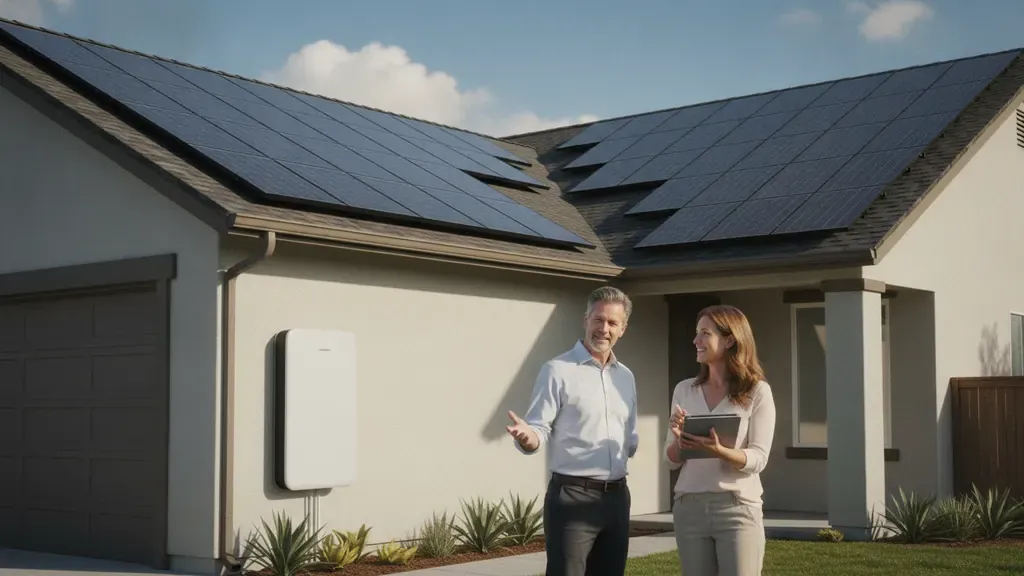
Learning how to pick a solar panel and battery backup system is less about finding one universally "best" brand and more about matching the equipment to your California home. Your roof, annual electricity use, inverter architecture, critical loads, outage expectations, monitoring needs, and plans for adding an EV or heat pump all affect the right design.
This guide gives you a practical buying framework before you compare proposals. It focuses on the decisions that shape a complete system, rather than repeating a battery-only brand comparison or a battery-sizing calculation.
Start with the job you want the system to do
Before comparing panel efficiency or battery capacity, define the job. A system intended to reduce grid purchases has a different design emphasis from one intended to keep refrigeration, medical equipment, internet service, or selected circuits operating through an outage. The best equipment list follows the outcome you need.
- Lower grid dependence: prioritize annual solar production, usable storage, and a control strategy that fits your utility rate plan.
- Outage protection: identify the circuits that must stay on and confirm the battery and transfer equipment can support their continuous and startup loads.
- Future electrification: account for an EV charger, heat pump, induction range, pool equipment, or other planned loads before the system is designed.
- Limited roof area: place more weight on panel output, efficiency, physical dimensions, and roof layout.
Write down your top two priorities and the loads you consider essential. This short exercise prevents a proposal from optimizing for a headline system size while missing the way your household actually uses energy.
How to pick a solar panel and battery backup system for your home?
Choosing a solar panel starts with the roof and your production goal, not with a product name. Panel wattage describes rated output under standard test conditions. It does not, by itself, predict how much electricity your roof will produce after accounting for orientation, shade, temperature, wiring, inverter limits, and seasonal conditions.
Compare output, efficiency, and physical fit
Use the proposal to compare the panel's nameplate output, efficiency, dimensions, temperature characteristics, degradation terms, and product warranty. Higher efficiency can be useful when roof space is constrained, while a physically larger panel may not fit well around vents, hips, valleys, skylights, or setbacks. Ask the installer to show the proposed layout, not only the total number of panels.
The U.S. Department of Energy's solar PV design overview explains that modules are only one part of a working system. Mounting, wiring, inverters, and the site's physical conditions all influence the finished design.
Review warranty language instead of relying on a headline
Ask what the panel warranty covers, who administers it, how a claim is handled, and whether the installer remains available after commissioning. A product warranty and a workmanship warranty are different documents. Your proposal should identify both, along with the process for service if a component underperforms.
Do not treat a longer stated term as proof that two panels are equal. Compare the conditions, exclusions, degradation language, labor coverage, and the companies standing behind the equipment. A reliable installer should explain those tradeoffs in plain language.
Check roof condition and solar placement together
Solar panels are a long-term roof attachment. If the roof needs replacement or significant repair, resolve that question before finalizing the array. An integrated solar and roofing contractor can evaluate the roof structure, covering, drainage, mounting method, and panel layout as one project. AMECO has operated in California since 1974 and later expanded into roofing, giving homeowners one company to coordinate the solar and roofing work.
For roof-specific planning, review AMECO's roofing solutions and the practical guidance in its article on solar panel battery backup. Those resources cover broader roof and storage considerations. This article's focus is the equipment-selection checklist that connects them.
Which inverter architecture fits your solar and battery plan?
The inverter is the system's traffic manager. Solar modules produce direct current (DC), while most household loads use alternating current (AC). The inverter converts and controls that energy, and the architecture you choose affects shading performance, battery compatibility, backup capability, monitoring, and expansion.
| Architecture | What to evaluate | Best question to ask |
|---|---|---|
| String inverter | Array layout, shade, string voltage, and future battery path | Will the array's roof planes perform well on shared strings? |
| Microinverters | Module-level conversion, shade variation, monitoring, and replacement access | Will module-level control improve this roof's design? |
| Hybrid inverter | Solar input, battery communication, backup output, and operating modes | Does this model support the battery and backup loads we intend to use? |
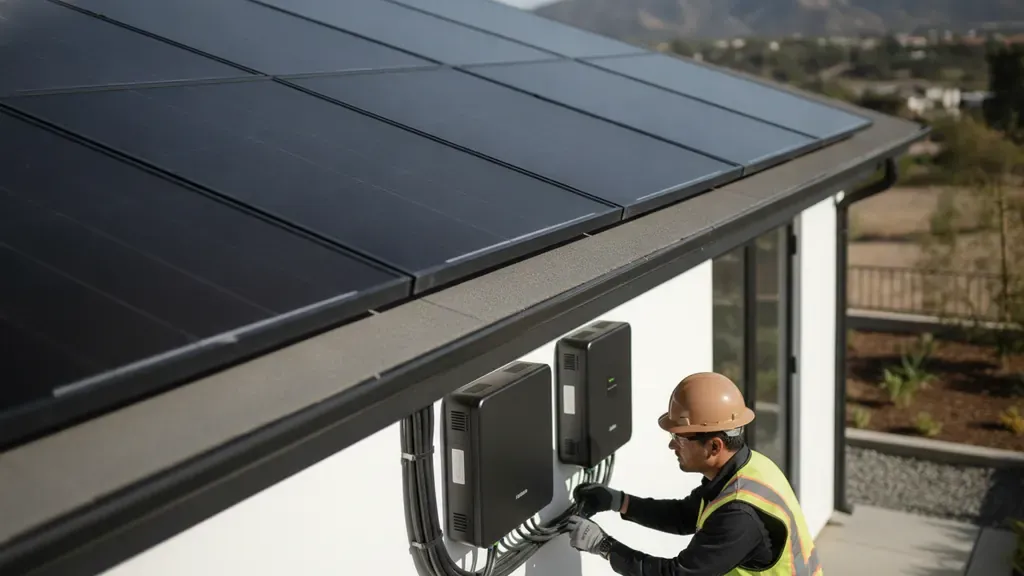
The DOE notes that PV systems may use a central inverter or microinverters at individual modules. When storage is included, the proposal should also explain whether the battery is AC-coupled or DC-coupled, which conversion stages are used, and what that means for a new installation or a retrofit.
Ask about compatibility at the system level
Do not approve a panel and battery as separate shopping-list items. Confirm that the modules, inverter, battery, backup interface, electrical panel, monitoring gateway, and control software are designed to operate together. The compatibility question includes more than a connector. It can involve voltage and current limits, firmware, communications, approved operating modes, transfer equipment, and utility requirements.
For an existing solar array, identify the current inverter model and ask whether the proposed battery can communicate with it. A retrofit may need different equipment from a new solar-plus-storage system. If the installer proposes replacing the inverter, ask what happens to existing monitoring, warranties, production data, and backup functionality.
AMECO's overview of solar solutions can help you understand the design and installation process. The right proposal should then translate that process into equipment-specific details for your property.
How should you size battery capacity and backup power?
Battery capacity and battery power answer different questions. Capacity, measured in kilowatt-hours (kWh), describes how much energy the battery can store. Power, measured in kilowatts (kW), describes how much energy it can deliver at one time. A battery can have enough stored energy for a long evening but still be unable to start or run several large loads simultaneously.
Separate energy duration from instantaneous demand
Start with a recent utility bill and a load list. Record which appliances run during the evening, which loads are essential during an outage, and which equipment has a high startup surge. Then ask the designer to show:
- nominal capacity and usable capacity;
- continuous charge and discharge power;
- short-duration or surge capability;
- estimated duration for the selected backup loads;
- minimum reserve state of charge and emergency settings;
- how the system recharges after an outage.
Usable capacity is more helpful than a nominal number because it reflects the portion of storage the operating controls make available. Runtime is not a fixed promise. It changes with weather, solar production, household demand, battery reserve settings, equipment condition, and the loads connected to the backup panel.
Choose whole-home or critical-load backup deliberately
Whole-home backup may require more power, more storage, electrical service changes, or load management than backing up a selected group of circuits. Critical-load backup can focus the system on refrigeration, lighting, communications, garage doors, and other priorities. Neither approach is automatically better. The correct choice depends on what you need to operate and what the electrical design can safely support.
Ask for a written backup-load diagram. It should identify the backed-up panel or circuits, the transfer or isolation equipment, the maximum supported load, and any appliances that must be managed manually. A solar array without properly configured islanding and backup equipment will not necessarily keep a home energized when the grid fails.
Review AMECO's Battery Backup Solutions
What outage priorities should shape the system?
California homeowners may be planning for short interruptions, longer outages, Public Safety Power Shutoffs, extreme weather, or simply more control over evening energy use. Those scenarios affect the required reserve, recharge strategy, backed-up circuits, and acceptable tradeoffs. State your outage priorities before the installer selects capacity.
- Short, occasional outages: prioritize automatic transfer, essential circuits, and enough power for the devices you cannot interrupt.
- Longer or repeated outages: ask how solar recharge works, how reserve settings affect runtime, and how the system behaves across multiple days.
- Medical or refrigeration needs: identify the equipment's continuous and startup requirements and discuss a dedicated backup plan with a qualified professional.
- Time-of-use management: ask how the controls schedule charging and discharge, and whether those settings can change as utility plans change.
The California Public Utilities Commission's Solar Consumer Protection Guide explains that batteries can store daytime solar for evening use and may provide limited backup power. It also advises homeowners to review rate-plan assumptions and the system's expected performance before signing.
How important are monitoring and controls?
Monitoring should help you understand whether the system is producing, storing, and using energy as designed. It is not a substitute for good equipment selection, but it can make problems easier to identify and decisions easier to explain.
During a proposal review, ask whether the monitoring platform shows solar production, household consumption, battery state of charge, grid import and export, outage status, and alerts. Confirm which gateway, internet connection, app, or subscription is required. Also ask who can diagnose a problem remotely and what information the installer needs for service.
Controls matter because the battery is not simply an on-or-off reservoir. Operating modes may prioritize backup reserve, bill management, self-consumption, or scheduled charging. Ask the installer to explain the default mode, the settings you can change, and which changes require professional support. A useful system is one your household can understand without guessing what the app is reporting.
Should you plan for future expansion?
Future expansion is easiest when it is part of the initial design. A homeowner may add an EV, electrify a water heater, remodel a kitchen, finish an ADU, or decide that more outage loads should be protected. Those changes may affect solar production, inverter capacity, electrical service, battery modules, backup circuits, and monitoring.
Ask these questions before signing:
- Can the battery accept additional modules later?
- Must future modules match the original model, firmware, or age range?
- Can the inverter and backup interface support the planned final capacity?
- Is there room in the electrical equipment for additional circuits or protection?
- Will the roof layout leave practical space for future panels?
- What changes would require a new design, permit, or utility review?
Do not pay for an expansion promise that is not documented. A proposal should distinguish between equipment that is physically modular and a system that is actually approved for later expansion under the manufacturer's instructions and the home's electrical design.
What should you compare when you learn how to pick a solar panel and battery backup system?
Two proposals can use similar panel and battery names while offering very different system designs. Compare the assumptions and deliverables, not only the total panel count or battery kWh. A clear proposal makes it possible to see what is included, what is excluded, and what will happen if site conditions change.
| Proposal item | What a clear proposal should show | Why it matters |
|---|---|---|
| Solar array | Panel model, quantity, layout, orientation, shade assumptions, and estimated production | Shows how the roof supports the production goal |
| Storage | Usable kWh, continuous kW, surge output, reserve, and backed-up loads | Connects storage size to actual outage performance |
| Electrical design | Inverter, transfer equipment, panels, wiring, permits, and interconnection scope | Reveals compatibility and project responsibilities |
| Service and monitoring | Warranty documents, app access, alerts, support contact, and commissioning steps | Sets expectations after installation |
Be cautious when a proposal relies on universal savings, a guaranteed runtime, or a generic production estimate without showing the assumptions. Your final figures depend on the property, roof, energy use, utility territory, equipment, operating settings, and eligibility for any applicable incentive. Ask for a property-specific design rather than treating an online calculator or a sales estimate as a promise.
Solar panel and battery backup checklist
Use this checklist during an installer consultation. A strong proposal should answer each question in writing or identify the site visit, engineering review, or utility step needed to answer it.
- What are my two primary goals: energy use, outage protection, or both?
- Is my roof ready for solar, and does the layout account for shade, setbacks, vents, and future repairs?
- What panel output, efficiency, dimensions, and warranty fit my roof?
- Which inverter architecture best fits the roof's shade pattern and my storage plan?
- Are the inverter, battery, backup interface, monitoring system, and panels approved to work together?
- What are the battery's usable kWh, continuous kW, surge capability, and reserve settings?
- Which circuits will run during an outage, and what happens to high-startup loads?
- How will the battery recharge during a long outage or several cloudy days?
- Can I add an EV, heat pump, or more battery capacity later?
- Who handles design, permits, inspections, interconnection, commissioning, and service?
AMECO's solar battery storage pros and cons guide can help you weigh the broader tradeoffs. Its battery storage comparison guide addresses a different question: how battery options compare. Use this checklist to make sure the selected battery is part of a complete solar and electrical design.
Calculate Your Project with a Property-Specific Solar and Battery Design
Frequently asked questions
What is the most important factor when choosing a solar panel?
The most important factor is how the panel fits the complete system and your roof. Compare output, efficiency, dimensions, shade behavior, warranties, layout, and inverter compatibility. A panel with a strong headline specification may not be the right choice if it creates a poor roof layout or conflicts with the rest of the design.
How many solar panels do I need for battery backup?
There is no universal panel count. The design depends on your electricity use, roof conditions, panel output, utility rules, battery capacity, outage goals, and how quickly you want the battery to recharge. Ask for the production assumptions and the relationship between array size, battery capacity, and backed-up loads.
What is the difference between battery capacity and battery power?
Battery capacity is the amount of energy stored, measured in kWh. Battery power is the rate at which the system can deliver or absorb energy, measured in kW. Capacity affects how long a load can run, while power affects how much can run at once and whether high-startup appliances can operate.
Can solar panels power my home during a grid outage?
Not automatically. Standard grid-connected solar systems generally shut down when the grid fails for safety reasons. Outage operation requires a compatible battery or other approved backup design, isolation from the grid, and an electrical configuration that supports the circuits you want to run.
Can I add a battery to an existing solar panel system?
Often, but compatibility must be confirmed. The installer should review your existing panels, inverter, electrical service, monitoring, warranties, and available installation space. The best retrofit path may use AC-coupled storage, replace an inverter, or require other equipment so the battery can operate safely and communicate with the system.
Should I choose whole-home or critical-load backup?
Choose based on the loads you need during an outage and the electrical design your property can support. Critical-load backup focuses storage and power on selected circuits. Whole-home backup may require more equipment and careful management of large loads. Ask for a circuit-level plan before choosing either option.
Plan the system around your home, not a product label
The right solar panel and battery backup system balances production, storage, inverter compatibility, outage priorities, monitoring, roof condition, and future expansion. California homeowners should also review utility and consumer-protection requirements, then compare proposals that clearly explain assumptions and responsibilities.
AMECO Solar & Roofing brings solar and roofing under one California-owned company, with continuous operation since 1974. For a design based on your roof, household loads, utility territory, and backup priorities, use the Get An Estimate form to start a project-specific conversation.


.svg)
