


Commercial vs Residential Solar Panels: Key Differences
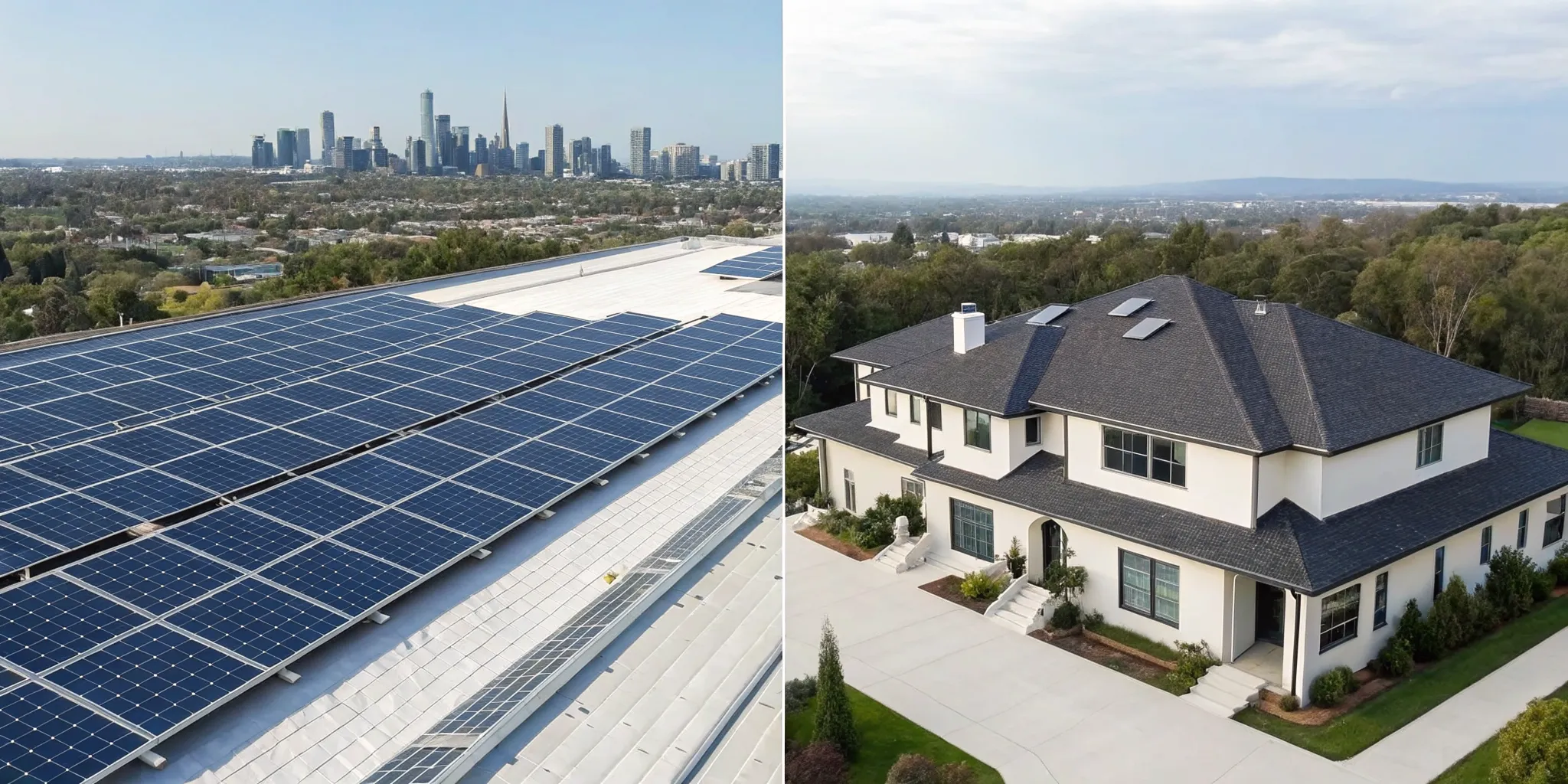
At first glance, a solar panel is a solar panel. But the system powering a family home is fundamentally different from the one on a sprawling commercial facility. It’s like comparing a home kitchen to a professional restaurant kitchen. Both are used for cooking, but the equipment, layout, and scale are designed for completely different purposes. The same is true when comparing commercial solar panels vs residential systems. One is tailored for household efficiency and aesthetics, while the other is engineered for maximum power output and financial return. Understanding this distinction is the first step in your solar journey, ensuring the system you choose is perfectly suited to your energy needs and property.
Key Takeaways
- Home vs. Business Goals: A residential system is tailored to your family's energy use and your home's appearance. A commercial system is a powerful workhorse designed to maximize energy production and offset a business's substantial operating costs.
- Understand the Investment: Homeowners can expect a smaller total cost and accessible financing options. Businesses make a larger initial investment but benefit from a lower cost per watt and unique tax advantages that create a strong financial return.
- Expect Different Timelines: A home solar installation is a quick project, often finished in just a few days with very little long-term maintenance. A commercial installation is a more complex process with a longer timeline for permits and construction.
Commercial vs. Residential Solar: What's the Real Difference?
When you see solar panels on a neighbor’s house and then on the roof of a large warehouse, you might assume they’re pretty much the same. While the fundamental technology is identical, the design, scale, and goals for residential and commercial solar projects are worlds apart. Think of it like the difference between a family car and a commercial delivery truck. Both have engines and wheels, but they’re built for entirely different jobs. A homeowner wants a system that blends with their home and covers their family’s energy use, while a business owner needs a powerhouse system to offset massive operational costs.
Understanding these distinctions will help you appreciate what goes into designing the right system for your specific needs. It’s not just about putting panels on a roof; it’s about creating a tailored energy solution that aligns with your property, your power consumption, and your financial goals. Let’s break down the key differences so you can feel confident about the path you choose for your home or business.
Comparing Size, Design, and Power
The most obvious difference between residential and commercial solar is scale. A typical home solar system is designed to offset the energy use of a single family, usually producing between 5 and 20 kilowatts (kW) of power. In contrast, a commercial system for a business or factory needs to support much heavier electrical loads and can easily scale to 100 kW or more.
This difference in power output is directly related to the panels themselves. Residential panels are smaller, often containing 60 to 120 solar cells, and are designed to fit neatly on the varied angles of a home’s roof. Commercial panels are physically larger, with 72 or more cells, to maximize energy production in a large, open space. They are built to be workhorses, prioritizing maximum output over fitting into a tight spot.
Understanding Panel Efficiency: Mono vs. Poly
Panel efficiency is simply a measure of how well a panel converts sunlight into usable electricity. While you might see a lot of technical jargon, the difference between residential and commercial panels is pretty straightforward. Commercial panels often have a slight edge in efficiency, typically ranging from 20% to 22%, because every square foot of roof space needs to generate as much power as possible to offset high energy costs.
Residential panels are incredibly effective as well, usually hovering between 18% and 21% efficiency. For a homeowner, the goal is to find a sweet spot between high performance and overall cost. This is why our solar solutions are always tailored to find this perfect balance for your home's unique energy profile and your budget, often using highly efficient monocrystalline panels that also offer a sleek, uniform look.
Reviewing Mounting Options and Aesthetics
Where and how panels are installed also differs greatly. For homeowners, aesthetics matter. You want a system that looks great and integrates seamlessly with your home’s architecture. Residential installations are typically mounted directly onto sloped roofs, following the existing roofline for a low-profile look. You can even see how panels might look on your own home with our 3D Home Visualizer.
Commercial buildings, on the other hand, often have large, flat roofs. This provides an ideal platform for mounting panels on tilted racks that can be angled perfectly toward the sun to maximize energy capture. Since we are also a roofing company, we have the expertise to ensure any installation, whether on a sloped or flat roof, maintains the integrity of the structure underneath for decades to come.
What Does the Installation Process Look Like?
Getting solar panels installed on your property is an exciting step, but it’s natural to wonder what the process actually involves. The journey from our initial consultation to flipping the switch on your new system is a well-planned project. The timeline and steps can vary quite a bit depending on whether we’re working on a home or a commercial building. A big piece of the puzzle is the behind-the-scenes work, like design, engineering, and securing permits, which happens before our crew even arrives.
At AMECO, we’ve refined this process over decades to make it as smooth and transparent as possible for you. We believe that a great installation experience is just as important as the quality of the panels themselves. Our approach is centered on clear communication and expert project management, so you always know what’s happening and when. We handle the complexities so you can focus on the future benefits of clean, reliable energy. Let’s walk through what you can typically expect for both residential and commercial installations.
The Residential Installation Process
For most homeowners, the physical installation of solar panels is surprisingly quick. Once your system design is finalized and all the necessary permits are approved, our professional crew can typically complete the entire on-site installation in just one to three days. We coordinate everything to minimize disruption to your daily routine. Our team works efficiently to mount the racking, install the panels, and connect the electrical components. We pride ourselves on leaving your property as clean as we found it. This streamlined process is one of the biggest perks for our residential customers, getting you closer to energy independence without a lengthy construction project.
The Commercial Installation Process
A commercial solar installation is a larger-scale project and naturally has a longer timeline. Due to the size and complexity, these installations can take several weeks or even months to complete. The process involves extensive structural evaluations of your building, close coordination with utility companies, and often more intricate mounting systems, especially for large, flat roofs. While it’s a more involved undertaking, our team manages every detail to ensure the project progresses smoothly. We understand that for commercial customers, time is money, so we work diligently to complete the installation efficiently while ensuring the final system is safe, robust, and built to perform for decades.
Breaking Down Permits, Approvals, and Timelines
A significant portion of any solar project timeline is dedicated to paperwork, not physical labor. Before we can install a single panel, we need to secure permits from your local city or county and get approval from the utility company. For residential systems, this process is often straightforward and can move relatively quickly. However, commercial permitting is much more complex, involving detailed engineering reviews that can take weeks. This administrative phase is critical for ensuring your system is safe and compliant with all regulations. Handling this is a key part of our approach; we manage all the applications, follow-ups, and inspections so you don’t have to.
Let's Talk Cost: What's the Investment?
Okay, let's get straight to the point: what does a solar system actually cost? It’s the number one question on everyone’s mind, and the answer depends entirely on your unique situation. Thinking of it as an investment, not just a purchase, is the right mindset. You’re investing in lower energy bills, a more stable power supply, and a healthier planet. The initial price tag for a home is very different from that of a business, and understanding why will help you see the full picture of your return on investment.
While the final number varies, the path to figuring it out is straightforward. It involves looking at your current energy usage, the size of your property, and the specific components you need. For example, adding a battery backup system will change the total cost, but it also gives you priceless energy independence during a blackout. The good news is that you don’t have to guess. You can get a clear idea of your potential costs and savings by using an estimate calculator to start planning your budget. From there, we can help you explore financing options and incentives that make the switch to solar more accessible than ever.
Calculating Costs for Your Home
For homeowners, the journey to solar is personal. Your system is designed specifically for your roof and your family’s energy needs. While the cost per watt can be a bit higher for residential projects compared to large-scale commercial ones, the total investment is significantly smaller and more manageable. Think of it like buying groceries; you’re not buying in the same bulk as a restaurant, so your total bill is much lower.
Most homeowners don’t pay for the entire system upfront. There are fantastic financing options, like solar loans, that allow you to get started with little to no down payment. These options often result in a monthly payment that is less than your current utility bill, so you start saving from day one. We can walk you through the numbers for your specific home, ensuring you find a path that fits your budget and financial goals as a residential customer.
Calculating Costs for Your Business
For a business, going solar is a major strategic move. The upfront investment is larger because the systems are bigger and more powerful, designed to offset significant energy consumption. However, this scale works in your favor. The cost per watt is typically lower for commercial projects, meaning you get more power for your money. This efficiency, combined with powerful financial incentives, leads to a very strong long-term return on investment.
Businesses can take advantage of incentives that aren't available to homeowners, including accelerated depreciation, which can provide a substantial tax benefit. When you combine these savings with the dramatic reduction in your monthly operating costs, the financial case for solar becomes incredibly compelling. We help our commercial customers analyze these factors to build a clear projection of their long-term savings and profitability.
Cost Per Watt vs. Total Investment
It might seem counterintuitive, but a project with a higher total cost can actually be the better deal on a per-unit basis. This is where the concept of "cost per watt" comes in. Commercial solar projects have a lower cost per watt because of economies of scale. When we buy panels and equipment in bulk for a large installation, the price per item goes down. Fixed costs, like project management and transportation, are also spread across a much larger system, further reducing the per-watt price.
So, while a business owner writes a bigger check initially, they are paying less for each unit of power their system will generate. For a homeowner, the total investment is smaller and more contained, but the cost for each watt is slightly higher because the project is smaller. Understanding this difference helps clarify why pricing is structured the way it is.
Factoring in Batteries and Other Components
Your solar panels are the star of the show, but they are part of a complete energy system. Other components, especially batteries, play a crucial role in how you use your power. In California, where power outages are a real concern, adding a battery backup is one of the smartest decisions you can make. It allows you to store the excess energy your panels produce during the day and use it at night or during a grid failure, giving you true energy independence.
Of course, adding a battery increases the initial investment, but the peace of mind and uninterrupted power it provides are invaluable. Beyond batteries, your system includes inverters, which convert solar energy into usable electricity for your home, and monitoring software. Modern systems make it easy to track your energy production right from an app on your phone, so you can see your investment at work in real time.
How Can You Save on Your Solar System?
Thinking about the price tag of a new solar system can feel a little daunting, but the initial investment is just one part of the story. The great news is that there are several powerful incentives and programs designed to make solar more affordable for both homeowners and businesses. These aren't just small discounts; they are significant financial tools that can dramatically reduce your upfront costs and shorten the time it takes to see a return on your investment. From federal tax credits that put money back in your pocket to state programs that pay you for the extra energy you produce, the path to solar savings is clearer than you might think.
Whether you're a homeowner looking to cut down on monthly utility bills or a business owner aiming to improve your bottom line, understanding these financial benefits is the first step. We'll walk through the most impactful ways you can save, including the federal solar tax credit, special depreciation rules for businesses, and net metering programs. We'll also touch on financing options that make the switch to solar accessible, even without a large upfront payment. You can even get a preliminary idea of your costs with our solar estimate calculator before diving into the details.
The Federal Investment Tax Credit (ITC)
One of the most significant financial incentives available is the federal solar tax credit, also known as the Investment Tax Credit (ITC). This isn't just a deduction; it's a dollar-for-dollar credit that reduces the federal income tax you owe. The ITC allows both homeowners and businesses to deduct a percentage of their total solar installation costs directly from their taxes. This can substantially lower the net cost of your system, making the switch to solar much more manageable from day one. The credit applies to the total cost of the system, including panels, inverters, mounting equipment, and labor. It’s a powerful tool for making your solar solution more affordable.
Accelerated Depreciation for Businesses (MACRS)
If you're a business owner, there's an additional tax benefit you can use. The Modified Accelerated Cost Recovery System (MACRS) allows businesses to recover the cost of their solar energy systems through depreciation. Instead of spreading that deduction over the entire lifespan of the equipment, MACRS lets you accelerate it over a much shorter period, typically five years. This front-loads your tax savings, which can provide a substantial improvement to your cash flow in the years immediately following your installation. This incentive makes going solar an even smarter financial decision for our commercial customers looking to reduce operating expenses and invest in sustainable infrastructure.
How Net Metering Benefits Homeowners
For homeowners, net metering is a fantastic benefit that helps you get the most value out of your solar panels. Here’s how it works: when your panels produce more electricity than your home is using, that excess power is sent back to the grid. Your utility company then gives you credits for that energy. These credits are applied to your electricity bill, offsetting the cost of any power you pull from the grid at night or on cloudy days. Net metering allows you to significantly lower your monthly electricity bills and ensures that none of the clean energy you generate goes to waste. It’s a key part of what makes solar a great long-term investment for residential customers.
Exploring Your Financing Options
You don't need to have all the cash on hand to go solar. There are plenty of financing options available to help you manage the upfront expense. Homeowners often use solar loans, which allow you to pay for your system over time with predictable monthly payments. For businesses, the options are even broader, including loans, leases, and other models that can make a large-scale installation financially feasible. Our team can walk you through the different paths to ownership and help you find a plan that fits your budget. Our personalized consultation process is designed to ensure you feel confident and informed about your financial choices every step of the way.
What to Expect for Efficiency and Maintenance
Once your solar panels are installed, what comes next? It’s natural to wonder about performance and upkeep. While both residential and commercial solar systems are built to last, their day-to-day efficiency and maintenance needs look a little different. The main reason for this is scale. A system designed for a family home has different priorities than one powering a large commercial building, and understanding these distinctions will help you know exactly what to expect from your investment.
For homeowners, the focus is on reliable, long-term performance that fits your roof and your budget. The hardware is designed to integrate smoothly with your home’s electrical system, and maintenance is refreshingly straightforward. For businesses, the goal is to maximize every square foot of space to generate as much power as possible, which often means more complex technology and monitoring. Understanding these differences helps set clear expectations for your own solar journey. Our approach is to customize every system, ensuring that its performance and maintenance plan are perfectly suited to your specific needs, whether it's for your home or business.
Decoding Panel Efficiency Ratings
When you see a panel’s efficiency rating, it’s just a measure of how much sunlight it can convert into usable electricity. For residential customers, panels typically have an efficiency between 18% and 21%. This range provides a fantastic balance of performance, durability, and cost, making it ideal for powering a home. These panels are optimized to work with standard home inverters and electrical setups.
Commercial systems, on the other hand, often push for maximum output, with efficiency ratings between 20% and 22%. Because businesses have higher energy demands and larger roofs, they might use advanced panels with features like half-cut cells to capture more energy. While a couple of percentage points might not sound like much, on a massive commercial array, it adds up to significant power generation.
Sizing Your System to Your Energy Needs
The size of a solar system is measured in kilowatts (kW), and it’s directly tied to how much electricity you use. A typical residential system produces between 5 and 20 kW, which is usually more than enough to cover a family’s daily energy consumption. We design these systems to fit neatly on your roof while generating the power you need to reduce or even eliminate your utility bill.
Commercial systems are on a completely different scale. Designed to power everything from office lights to heavy machinery, these arrays can easily exceed 100 kW. They are custom-engineered to meet the high energy demands of a business running all day. You can get a rough idea of your own energy needs by using an estimate calculator to see what size system might be right for your home.
A Look at Cleaning and Routine Inspections
One of the best things about residential solar is how low-maintenance it is. For the most part, your panels just need an occasional cleaning to wash away any dust or debris that might block the sun. California’s seasonal rain often takes care of this for you. Beyond that, a quick check of your monitoring app is all you need to ensure everything is running smoothly.
Because commercial systems are larger investments tied to business operations, their maintenance is a bit more involved. They often rely on sophisticated remote monitoring to track performance in real-time and identify any issues immediately. Regular professional inspections are also more common to protect the asset and ensure consistent output. The health of your roof is also key, so having solid roofing solutions in place is foundational to any good solar installation.
How to Monitor Your System's Performance
Keeping an eye on your solar system’s performance is simple and empowering. As a homeowner, you’ll typically use a straightforward mobile app that connects to your system. With just a few taps on your phone, you can see how much energy your panels are producing, track your home’s energy consumption, and watch your savings grow. It’s an easy way to feel connected to your energy production and understand your environmental impact.
Commercial monitoring is more granular. Businesses often use specialized software that provides detailed, real-time data on every part of the array. This allows facility managers to track output, predict energy generation, and ensure the system is performing at peak efficiency to support their operational needs. For homeowners, our solar solutions always include user-friendly monitoring to put the power of information right in your hands.
Debunking Common Solar Myths
Going solar is a big decision, and it’s easy to get tangled up in the myths and misinformation floating around. You’ve probably heard a few things that made you pause and wonder if solar is really the right move. Let's clear the air and tackle some of the most common misconceptions head-on. Getting the facts straight is the first step toward making a confident choice for your home and your energy future.
Myth: "Solar is too expensive for my home."
This is probably the biggest hurdle for most people, but the idea that solar is out of reach is outdated. While there is an upfront investment, it's more affordable than ever. Think of it less as an expense and more as a long-term investment in your home's value and your financial future. Financial incentives, like the federal solar tax credit, can significantly reduce the initial cost. Over time, the money you save on your electricity bills adds up, and the system eventually pays for itself. You can even use our estimate calculator to get a clearer picture of the costs and potential savings for your specific home.
Myth: "Solar panels only work when it's sunny."
It’s a logical assumption, but thankfully, it’s not true. Solar panels generate electricity from daylight, not just direct, blistering sunlight. While they are most productive on clear, sunny days, they continue to produce energy even when it's cloudy. Modern panels are highly efficient and can capture diffuse sunlight that passes through clouds. Here in California, we get plenty of sunshine to maximize production, but you can rest easy knowing your system is still working for you on those overcast days. Our solar solutions are designed to perform reliably in real-world weather conditions, ensuring you get consistent power.
Myth: "My system will work during a blackout."
This is a common and potentially dangerous misunderstanding. For safety reasons, standard grid-tied solar systems are designed to automatically shut down during a power outage. This prevents your panels from sending electricity back to the grid while utility workers are trying to fix it. However, this doesn't mean you have to be left in the dark. By pairing your solar panels with a battery backup system, you can store excess energy to use when the grid goes down. This combination is what gives you true energy independence and keeps your lights on during a blackout.
Myth: "Commercial and residential maintenance are the same."
While both systems use similar technology, their maintenance needs are quite different. Commercial solar installations are often massive and complex, requiring specialized monitoring and more frequent, intensive upkeep. In contrast, the systems designed for residential customers are built for durability and simplicity. Your home solar system requires very little maintenance, usually just an occasional cleaning to remove any dust or debris that might accumulate. We design residential systems to be a "set it and forget it" solution, so you can enjoy the benefits without adding a major chore to your to-do list.
How to Choose the Right Solar System
Deciding on a solar system can feel like a huge undertaking, but it doesn't have to be complicated. The "right" system is simply the one that fits your unique energy needs, property, and financial goals. The path to choosing a system looks a little different for homeowners than it does for business owners, but the core idea is the same: creating a solution that works for you.
Whether you’re looking to power your home or your business, the first step is understanding your specific requirements. How much energy do you use each month? What are the physical characteristics of your roof and property? What’s your budget, and what are your long-term financial goals? Answering these questions will help you determine the ideal size, type, and configuration for your solar installation. From there, you can explore the different incentives and financing options available to make your transition to solar as smooth as possible.
Key Considerations for Homeowners
As a homeowner, your solar system is all about meeting your family’s daily energy needs. Residential solar systems are designed specifically for this, typically producing between 5 and 20 kilowatts of power. Don’t let the initial cost intimidate you; many homeowners use financing options like solar loans to manage the upfront expense. Plus, going solar is a smart financial move for the future. Homes with solar panels often have a higher resale value, making it an investment that pays you back when it’s time to sell. AMECO offers a variety of solar solutions tailored for residential properties.
Key Considerations for Business Owners
For business owners, a solar installation is a strategic investment in your company’s future. Commercial solar systems are built on a much larger scale to handle higher energy demands, often exceeding 100 kilowatts. While the initial investment is larger, so are the financial rewards. Businesses can take advantage of significant incentives, including federal tax credits and accelerated depreciation, which can lead to a strong long-term return on investment. This makes solar a powerful tool for reducing operating costs and improving your bottom line. You can explore how AMECO supports commercial customers in achieving their energy goals.
Get Started with AMECO Solar & Roofing
The single most important step in choosing the right solar system is getting a professional assessment. This is where an expert evaluates your property, analyzes your energy consumption, and discusses your financial goals to design a system that’s a perfect fit. This personalized consultation ensures you get a solution tailored to your specific circumstances, whether you're a homeowner or a business owner. To see what this process looks like, you can learn more about our approach and how we create a seamless plan for your switch to solar.
Related Articles
- How to Use a Commercial Solar Panel Cost Calculator
- Solar Panels for Your Business: A Complete Guide
- Commercial Solar Panel | Solar Panel Company | AMECO Solar
- Residential Solar Panel | Solar Panel Company | AMECO Solar
- Professional Solar Installation: A Complete Guide
Frequently Asked Questions
Do I need to replace my roof before installing solar panels? That’s a great question, and the answer depends on the age and condition of your current roof. Solar panels are built to last for 25 years or more, so you want to be sure your roof is just as durable. During our initial assessment, we conduct a thorough inspection of your roof’s structure and health. Since we are also a roofing company, we can give you an honest, expert opinion and handle any necessary repairs or replacements, ensuring your entire system is solid from the foundation up.
How do I know if a battery backup is the right choice for me? A battery is a fantastic addition if your main goals are energy independence and peace of mind. If you want to keep your lights and essential appliances running during a power outage, a battery is the way to do it. It stores the extra solar energy you produce during the day so you can use it at night or when the grid goes down. For many California homeowners, knowing they won't be left in the dark during an outage makes a battery an essential part of their solar system.
What's the very first step I should take if I'm considering solar for my home? The best first step is to get a clear picture of your energy needs and potential savings. A great starting point is to use an online tool, like our solar estimate calculator, to get a preliminary idea of costs. After that, the next move is to schedule a professional consultation. This allows us to look at your specific property, analyze your utility bills, and design a system that is perfectly tailored to your home and your financial goals.
How long does the entire solar process take, from the first call to flipping the switch? The full timeline involves more than just the on-site installation. After our initial consultation and your design approval, a significant portion of the time is dedicated to securing permits from your local city and getting approval from the utility company. This administrative phase can take several weeks. Once we have the green light, the physical installation on your home is surprisingly fast, usually taking just one to three days. We manage the entire process so it feels seamless for you.
What happens to the solar panels if I decide to sell my house? Solar panels are a permanent fixture that adds significant value to your property. Studies have shown that homes with solar panels often sell faster and for a higher price than comparable homes without them. The system is typically transferred to the new owner along with the home, making it a very attractive feature for potential buyers who are excited about the prospect of lower electricity bills from day one.


.svg)
