


Solar for Farms California: Powering Agricultural Operations
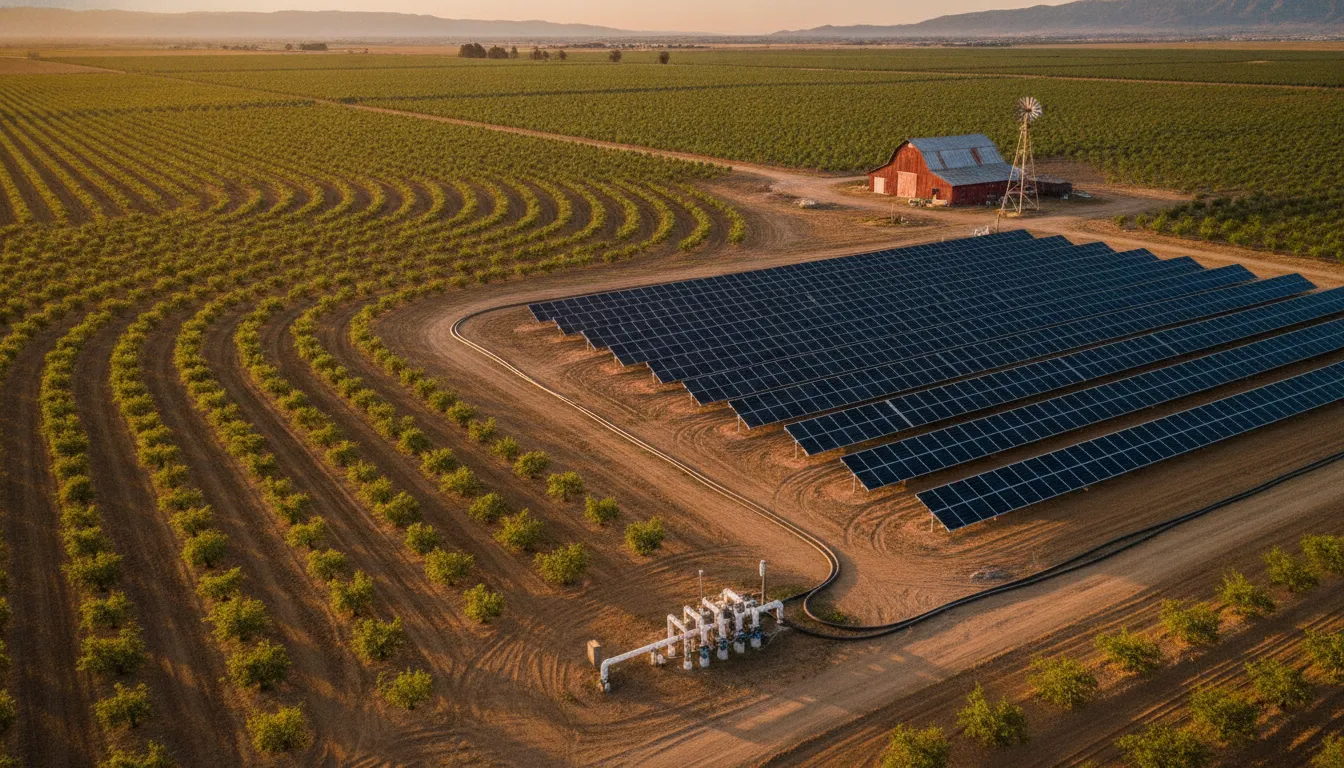
For a California farm, electricity is tied directly to production. Irrigation pumps, refrigeration, lighting, and processing equipment may need dependable power through demanding operating seasons, while utility costs and outage risks can complicate planning. Because agriculture is vital to California's economy and global food supply, energy resilience is more than a facilities concern.
Get a free farm solar estimate to see how solar for irrigation, cold storage, and processing could fit your operation.
Solar for farms California can help power irrigation, cold storage, barns, and processing facilities while reducing reliance on grid electricity. The right system depends on the property's load profile, roof or ground space, utility territory, storage needs, and incentive eligibility, so project-specific engineering matters.
California's Renewable Energy for Agriculture Program notes that onsite renewable energy can reduce greenhouse gas emissions and increase energy reliability. Those benefits become clearer when solar is evaluated around the equipment and operations that keep a farm running, starting with its daily irrigation and production demands.
Why California Farms Are Turning to Solar for Irrigation and Operations
California agriculture depends on reliable energy as much as it depends on water, equipment, and skilled labor. The state's agricultural production is important to the California economy and global food security, so interruptions to essential systems can affect more than a single property. On-site solar gives farm owners another way to produce electricity where it is used, while potentially reducing demand for grid power.
The California Energy Commission explains that renewable energy projects can help agricultural operations reduce greenhouse gas emissions and increase energy reliability. The value is practical: a properly designed system can support the loads that keep crops moving from field to market.
Irrigation pumps
Irrigation is one of the clearest applications for agricultural solar. Pumps may operate on a regular schedule or need to respond to crop conditions, water availability, and seasonal demand. Solar can help supply electricity for pumping during daylight production hours, when arrays are generating power. The right design depends on pump size, operating schedules, well characteristics, storage tanks, and the property's electrical service.
That assessment matters because a farm's energy profile is rarely uniform. An operation may need substantial power during irrigation season, then shift toward refrigeration, lighting, or processing at other times. Reviewing those patterns before equipment is selected helps align the system with actual use rather than relying on a generic array size.
Cold storage and refrigeration
Perishable crops and other agricultural products require controlled temperatures after harvest. Cold rooms, refrigeration equipment, and ventilation can create steady electrical demand, particularly when outside temperatures rise. Solar generation can offset a portion of that demand, while battery storage may provide an additional layer of resilience for critical equipment during grid outages. Storage capacity and backup loads should be evaluated separately, since not every operation needs to keep every electrical load running.
Barns and processing
Barns, packing areas, workshops, and processing facilities can add lighting, motors, fans, pumps, and control systems to a farm's load profile. A coordinated plan can account for these uses alongside irrigation and refrigeration. For properties with aging agricultural buildings, it is also important to review roof condition and structural considerations before installation. AMECO's commercial solar installation for agricultural operations approach connects site assessment, system design, and installation planning so the project supports the property as a whole.
What Agricultural Solar Can Power on Your Property
The most useful farm solar systems are designed around the loads that keep production moving. Rather than treating solar as a separate energy project, California operators can evaluate it alongside irrigation schedules. Harvest cycles, refrigeration needs, and the electrical demands of barns or processing areas. The California Energy Commission identifies irrigation pumps, cold storage facilities, and processing equipment as examples of essential agricultural infrastructure that can use onsite renewable energy.
Irrigation pumps and water management
Irrigation can be one of the clearest places to begin a load assessment. Solar electricity may support pumps that move water from wells, reservoirs, or holding tanks to fields, orchards, and greenhouse systems. The right design depends on pump horsepower, operating hours, seasonal water demand, controls, and the available electrical service. A system may be sized to serve daytime pumping directly, while batteries or other controls can help coordinate energy use when pumping must continue beyond solar production hours.
Water management equipment can also include pressure systems, filtration, fertigation controls, and monitoring devices. These smaller loads should be considered with the primary pumps rather than overlooked during early planning. Mapping when each load runs helps identify where solar production, storage, and utility power can work together.
Cold storage and refrigeration
Cold rooms, pack-house refrigeration, freezers, and ventilation equipment can draw power throughout the harvest and distribution process. Solar can help offset the electricity used to cool produce after picking and maintain the conditions required before shipment. Because refrigeration loads may cycle at different times of day, an energy review should examine both peak demand and total daily consumption.
Roof condition matters here, particularly when panels are considered for a packing or cold-storage building. Reviewing the roof and electrical infrastructure together can reduce the risk of installing a long-lived solar array on a surface that needs near-term work. For a planning framework, review solar project costs for farms, remembering that project figures depend on the building, equipment, utility territory, and site conditions.
Processing, barns, and day-to-day operations
Farm processing may include washing, sorting, conveyors, milling, drying, or other electrically powered steps. Solar can also be evaluated for barn lighting, ventilation, fans, controls, security systems, and workshop equipment. These loads often have different operating patterns, so combining them into one property-wide profile gives a more useful picture than sizing around a single machine.
A qualified solar assessment should document the equipment, service capacity, roof or ground-mount options, and future expansion plans before recommending system size. That practical approach helps align the project with how the farm actually operates.
USDA REAP Grants and Federal Tax Credits for Farm Solar
Federal incentives can materially affect how a California agricultural operation evaluates a solar project. Treat them as planning inputs rather than guaranteed savings. Two programs often enter the conversation: the U.S. Department of Agriculture's Rural Energy for America Program (REAP) and the federal clean energy investment tax credit.
How REAP can support an agricultural solar project
REAP provides guaranteed loan financing and grant funding to agricultural producers and qualifying rural small businesses for renewable energy systems and energy-efficiency improvements. For eligible solar projects, USDA program materials describe grants of up to 50% of eligible project costs and loan guarantees of up to 75%. When financing and grant support are combined, the total assistance may reach up to 75% of eligible costs, subject to the program's rules, application requirements, and available funding.
That assistance is not an automatic discount on every installation. Eligibility can depend on the applicant's business structure, rural location, project scope, technical documentation, and timing. A farm may need to provide financial information, energy-use details, equipment specifications, and evidence that the proposed system meets current program requirements. Review the current USDA REAP guidance before relying on any percentage or planning an application. Program availability, funding levels, deadlines, and eligible-cost definitions can change.
Layering REAP with the federal clean electricity credit
A qualifying solar installation may also be evaluated for the federal investment tax credit, now addressed through the clean electricity credit provisions of the Internal Revenue Code. The credit's value and eligibility depend on the project, taxpayer, placed-in-service timing, labor requirements, domestic-content or energy-community provisions, and other current rules. The credit is generally considered separately from a grant. So a tax professional should determine how the proposed REAP assistance and federal tax treatment interact for the farm's specific ownership and financing structure.
For that reason, an estimate for commercial solar installation for agricultural operations should be paired with financial and tax review. The right analysis accounts for the farm's load profile, utility territory, roof or ground-mount conditions, storage needs, and eligibility for each incentive. Searching for a "USDA REAP solar grant California" opportunity is a useful starting point, but it is not a substitute for confirming current USDA and IRS requirements.
Before committing to equipment or an application deadline, confirm the latest program status directly with USDA Rural Development and a qualified tax professional. Incentives can improve project feasibility, but the final result depends on the property's characteristics. The farm's finances, and the rules in effect when the project is submitted and placed in service.
Net Metering and Battery Storage for Agricultural Customers
How a farm uses its electricity can matter as much as how much it generates. Irrigation, refrigeration, processing, and other agricultural loads may operate on different schedules, so the value of exported power depends on the farm's utility, rate structure, and load profile. California's net energy metering and net billing rules can provide credits for electricity exported to the grid, but the credit is not automatically equal to the retail rate. The California Public Utilities Commission explains that the Net Billing Tariff, in effect for new customers since April 15. 2023, uses energy export credits that can vary by time and market conditions. In some high-value periods, including late-summer evenings, export credits may exceed retail value. Review the CPUC's current net energy metering guidance before modeling a project.
| Factor | Solar only | Solar + battery storage | No solar |
|---|---|---|---|
| Monthly bill impact | May reduce grid purchases when generation aligns with on-site use; results depend on the utility rate and farm load. | May shift more solar energy to later use and reduce selected peak-period purchases; battery controls and tariffs affect the result. | Electricity is purchased from the utility under the applicable rate, with no on-site generation or export credits. |
| Outage backup | Typically does not provide power during an outage unless the system includes approved backup equipment. | Can provide backup power for selected loads during grid outages when designed with the appropriate controls and capacity. | No solar-based backup; resilience depends on utility restoration or a separate generator or storage system. |
| Export credit value | Excess generation may receive credits under the applicable NEM or Net Billing rules, with value varying by time and utility. | Can store some excess generation for on-site use, while remaining exports are subject to the applicable credit rules. | No solar generation to export and no related export credits. |
| Upfront cost | Solar equipment, engineering, interconnection, and installation costs apply. | Includes solar costs plus battery equipment, controls, engineering, and installation. | No solar project cost, though ongoing utility purchases remain. |
Storage can be particularly relevant when a farm needs continuity for essential equipment. California agricultural solar installations can often be paired with batteries for backup power during grid outages, as described by California Climate Investments. The system still needs to be sized around the loads that matter most. Such as controls, refrigeration, communications, or water systems, rather than assuming every building will remain energized.
Incentives can also change the comparison. California has offered storage incentives, and SCE or PG&E customers with qualifying interconnections before the end of 2027 may be eligible for an export adder. Eligibility, program terms, and utility requirements can change, so an agricultural project should be evaluated using current information and the property's actual interval load data. AMECO can help compare solar-only and solar-plus-storage designs around the farm's operating schedule, resilience priorities, roof conditions, and utility territory.
Request an agricultural solar consultation and let AMECO compare solar-only and solar-plus-storage options for your property.
Agrivoltaics: Combining Crops and Livestock with Solar Panels
California agriculture depends on productive land, reliable energy, and careful water management. Agrivoltaics offers a way to address those needs together by co-locating solar panels with agricultural production. Instead of treating a solar array and a farm as competing land uses. A properly designed project can provide electricity while creating useful shade and preserving the underlying agricultural function. The U.S. Department of Energy defines agrivoltaics as this combination of solar energy and agricultural production, including arrangements that shade crops while generating power.
The approach is especially relevant in the Central Valley. The region uses less than 1% of U.S. farmland yet supplies about one-quarter of the nation's food. At the same time, a 2022 USDA survey found that roughly 117,000 U.S. farm operations had some type of solar device. Those figures point to a practical opportunity: expand on-site energy production without automatically converting productive farmland into a conventional solar site.
Using shade where it can support production
Panel height, row spacing, orientation, and crop selection all influence whether an agrivoltaic project fits a particular operation. In some settings, partial shade can help moderate heat and reduce direct exposure for suitable crops. The result is not universal, however. Agronomic conditions, equipment access, harvest methods, water needs, and seasonal sunlight must be evaluated before a design is selected.
Grazing sheep beneath elevated arrays
Livestock grazing is another established dual-use concept. Sheep can manage vegetation beneath and around elevated panels, reducing the need for mechanical mowing in appropriate areas while keeping the land in agricultural use. The array must be designed around animal movement, fencing, maintenance access, and electrical safety. A farm operator should view grazing compatibility as a site-specific management plan, not an automatic benefit of any solar installation.
A forward-looking strategy for California growers
For growers and agricultural property owners, the value of agrivoltaics extends beyond electricity production. Co-location can reduce land-use conflict, support farm continuity, and create a more flexible path toward energy resilience. California's agricultural sector is vital to the state economy and global food security, so energy improvements should be planned around the operation rather than imposed on it. A solar professional familiar with agricultural load profiles can assess whether shade structures, elevated arrays, or other configurations make sense for the property. For background on commercial applications, see our commercial solar installation for agricultural operations resource.
Working with AMECO for Farm Solar and Roofing
A farm solar project has to work with the buildings, equipment, and operating demands already in place. AMECO Solar & Roofing takes a consultative approach, reviewing the property, roof conditions, electrical loads, and long-term goals before recommending a system. As a California-owned contractor operating continuously since 1974, AMECO supports commercial and agricultural clients through the project from design through installation. Its AMECO's commercial solar capabilities are designed for the practical demands of working properties, not a one-size-fits-all residential installation.
One contractor for the roof and solar system
Barns, equipment sheds, cold-storage buildings, processing facilities, and shop roofs all need to remain watertight while supporting a productive operation. Coordinating roofing and solar through one contractor can help reduce handoff problems between separate teams. If a roof needs repair, replacement, or additional evaluation before panels are installed. That work can be considered as part of the overall design rather than discovered after installation.
AMECO's integrated solar and roofing approach keeps roof integrity and solar performance in the same conversation. That matters for agricultural owners planning a long-term infrastructure investment, especially when roof access, mounting methods, drainage, and future maintenance all affect the installation.
Design around agricultural operations
Farm energy use is shaped by schedules and equipment. Irrigation pumps may create substantial seasonal demand, while refrigeration and cold storage require dependable power beyond a single harvest window. Processing equipment, lighting, ventilation, and shop loads add further variables. AMECO can evaluate these needs as part of a commercial design process and consider whether battery storage or other system features fit the property's goals.
The right next step is a property-specific assessment. Roof age, structural conditions, utility territory, equipment loads, available space, and eligibility for incentives can all affect the recommended approach. A qualified consultation helps an owner compare options without relying on universal pricing, savings, or installation-time promises.
Start today with a property-specific farm solar review from AMECO's commercial solar team.
Frequently Asked Questions
What is the USDA Renewable Energy for America Program?
The USDA Renewable Energy for America Program, or REAP. Provides guaranteed loan financing and grant funding to eligible agricultural producers and rural small businesses for renewable energy systems and energy-efficiency improvements. Eligibility, funding availability, and application requirements can change, so confirm current details with the USDA REAP program before planning your project.
Can farm solar power irrigation pumps and cold storage?
Yes. A properly engineered system can support major agricultural loads such as irrigation pumps, refrigeration and cold storage, processing equipment, barn lighting, and other facility operations. The design should begin with interval energy data, equipment ratings, operating schedules, and the farm's utility service, rather than with panel count alone.
How does net metering work for agricultural solar customers?
Under California's net energy metering rules, eligible solar owners can receive credits for electricity exported to the utility grid. The applicable tariff, export value, interconnection requirements, and treatment of batteries depend on the utility, system configuration, and customer eligibility. Review current guidance from the California Public Utilities Commission before estimating project economics.
What is agrivoltaics, and can it work on California farmland?
Agrivoltaics co-locates solar panels with agricultural production, allowing a property to generate electricity while continuing selected crop or livestock activities. Panel height, row spacing, shade patterns, access for equipment, water management, and the specific crop or grazing plan all affect feasibility. A site study should address both agricultural productivity and electrical performance.
Should a farm add battery storage to its solar system?
Battery storage can help provide backup power during grid outages and may improve how a farm uses on-site solar. It can be especially relevant where refrigeration, controls, communications, or water systems must remain available. The right battery size depends on critical loads, outage goals, utility rules, interconnection limits, and the property's electrical profile, so storage should be evaluated alongside the solar design.
Get started with a farm solar estimate
Every agricultural property has different energy loads, roof conditions, utility requirements, and project considerations. A property-specific review can help you evaluate how solar may support irrigation, storage, processing, or other operations while identifying the right next steps. To discuss your goals with AMECO's commercial solar team, get an estimate.


.svg)
