


Commercial Solar Near Me: A California Business Guide

Choosing a commercial solar provider is not simply a matter of finding the closest company in a search result. A sound decision starts with confirming service-area coverage and commercial experience. It also depends on the provider's ability to evaluate your roof, electrical system, energy use, and utility requirements as one connected project.
When comparing commercial solar near me, look for a California provider that can document relevant commercial work. The provider should explain site-feasibility findings, coordinate permitting and interconnection, address roof conditions, and define monitoring and post-install support in writing. AMECO is California-owned and has operated since 1974, with solar, roofing, battery storage, and EV charging capabilities.
Before comparing proposals, request a project-specific review and gather the information a provider needs to assess your property. The right evaluation then moves from local fit to the questions that reveal whether a proposed system is practical for your business.
What should a California business look for in commercial solar near me?
For a business owner, CFO, or facilities manager, choosing commercial solar near me should mean evaluating project capability, not simply selecting the provider with the closest listing. Start by confirming that the company serves the property's California utility territory and can explain how local permitting and interconnection requirements affect the work. Coverage should be confirmed for the specific address, especially when a provider references multiple regions or utility territories.
Next, ask for evidence of comparable commercial work. A provider should be able to discuss projects involving facilities similar to yours, whether that means a warehouse, office, retail property, or manufacturing site. Request references, project scopes, and an explanation of who handled engineering, installation, inspections, and final system handoff. Experience should be demonstrated through process and documentation, not only through a project-size claim.
Evaluate the full project process
Commercial solar requires coordination across the roof, electrical system, utility, permitting authority, and the business's operating schedule. Ask how the provider will assess roof condition and structural capacity, review historical energy use, design around electrical constraints, and identify equipment locations. The proposal should make clear which party is responsible for engineering, permit submission, utility applications, inspections, commissioning, monitoring, and employee training.
California projects may also involve utility-specific interconnection procedures. The California Public Utilities Commission explains that Rule 21 covers interconnection, operating, and metering requirements for eligible generation facilities connected to investor-owned utility systems. Each utility administers the process in its own territory, so you can review the CPUC's Rule 21 guidance and ask which requirements apply. A qualified provider should explain the applicable process without presenting approval or timing as automatic.
- Which commercial properties and system types has the company completed?
- Who performs the engineering and manages permits and utility coordination?
- How will roof, structural, electrical, and operational constraints be documented?
- What support, monitoring, training, and escalation process follows commissioning?
AMECO's AMECO commercial solar services page provides a starting point for reviewing its commercial capabilities and project approach. Before selecting any provider, compare the answers, documentation, and site-specific assumptions in writing. When useful, request a site-specific estimate rather than treating a generic online result as a recommendation.
How does a provider evaluate your roof and electrical site?
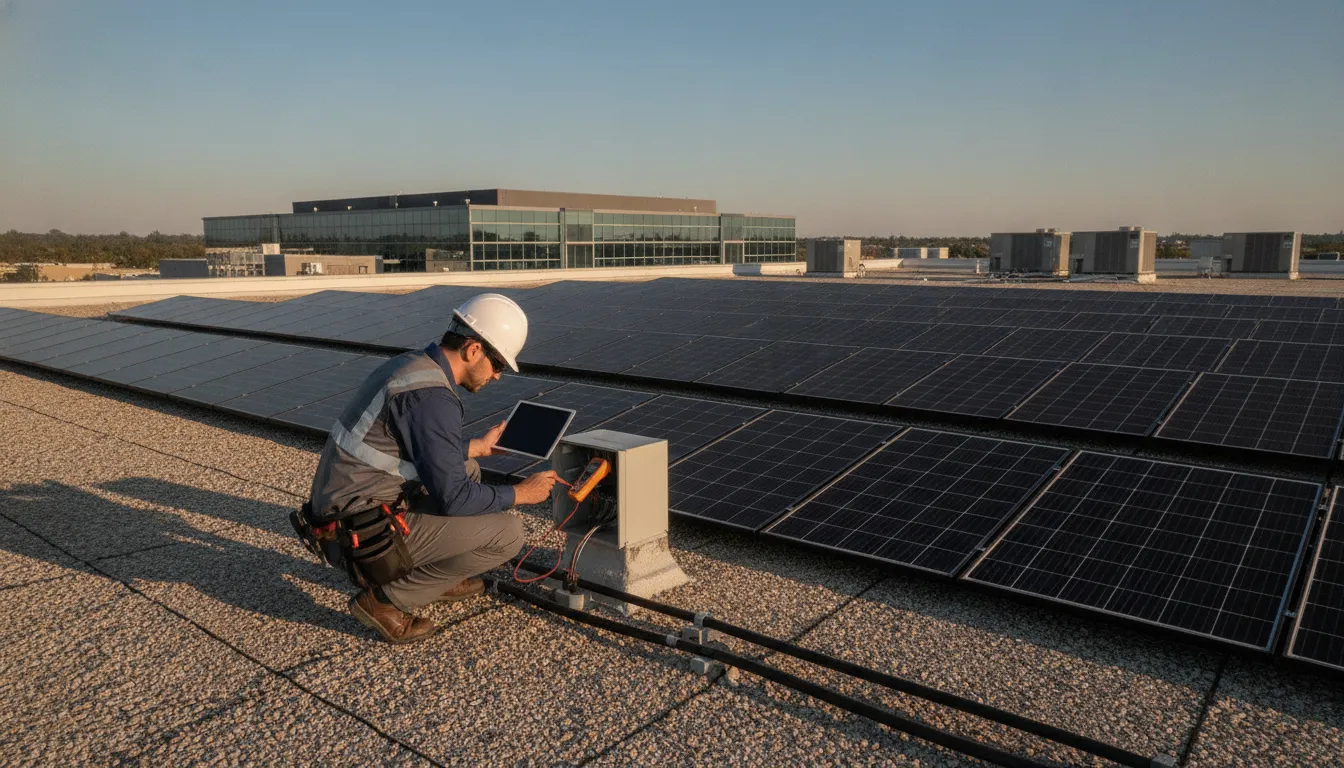
A credible commercial solar assessment begins with the property, not a standard system size. The provider should review the building's roof condition, remaining service life, material, drainage, structural capacity, and any planned replacement. Rooftop equipment, parapets, trees, neighboring buildings, and other obstructions can affect the usable array area and shading profile. The U.S. Department of Energy's pre-audit checklist includes roof direction, pitch, structural soundness, roof-covering condition, and unobstructed areas among its screening considerations.
That roof review matters because installing solar on a roof that may soon need major work can create avoidable scope and coordination problems. Ask how the assessment accounts for roof repairs or replacement, attachment methods, access, and the relationship between roofing and solar warranties. AMECO's commercial solar roof assessment guide offers additional context on evaluating roof readiness before moving forward.
What should the electrical review cover?
The electrical assessment should connect the proposed array to the building's actual operations. A provider may review utility bills and energy-use patterns. The provider should then verify the service panel's location, amperage, available space, interconnection path, meter configuration, and room for related equipment. If battery storage is under consideration, the site review should also address an appropriate, well-ventilated location and the operational goals the system is expected to support.
How do shading and utility requirements affect feasibility?
Shade from trees, adjacent buildings, rooftop air handlers, and other equipment can change the layout and expected production profile. A thorough design documents these constraints instead of assuming every roof area is equally usable. The provider should also identify the property's utility territory and explain the applicable interconnection process. In California, requirements vary by utility. The California Public Utilities Commission explains that each investor-owned utility administers Rule 21 within its own service territory. The final design and approvals must therefore reflect the specific property and utility.
- Roof condition, material, structure, access, and planned replacement.
- Array area, orientation, pitch, shading, and rooftop obstructions.
- Energy use, operating schedule, electrical service, and equipment location.
- Utility territory, interconnection requirements, and permitting responsibilities.
Use the assessment to compare the quality of each provider's questions and documentation. A sourced feasibility review should make constraints visible before you compare system designs or project economics.
Which energy goals should shape a commercial solar design?
A commercial solar system should be designed around how a business uses electricity, not around a standard system size. Start with the load profile: when the facility consumes power, which operations create the largest demand, and how usage changes by season or production cycle. A warehouse with daytime refrigeration needs may have different priorities from an office that empties after business hours. Reviewing interval usage, utility bills, operating schedules, and planned changes helps the design reflect the property rather than a generic model.
Decision-makers should also clarify the primary objective. Is the project intended to increase on-site energy use, manage exposure to changing utility costs, support resilience during outages, or advance a documented sustainability plan? These goals can point to different equipment and operating strategies. In California, utility territory and interconnection requirements also matter. For investor-owned utilities, the California Public Utilities Commission explains that Rule 21 addresses interconnection, operation, and metering requirements, while each utility administers its own version of the tariff: review the applicable Rule 21 requirements.
Battery storage may be relevant when the business needs more control over when energy is available, has critical loads, or wants to evaluate backup capabilities. Storage should be assessed alongside the facility's electrical configuration, safety requirements, available space, ventilation, and operating priorities. It is not automatically the right fit for every site. A provider should explain what loads a proposed battery system is intended to support and what limitations apply.
Get An Estimate for a site-specific commercial solar review
Plan for the future as well. New production equipment, expanded operating hours, fleet electrification, building additions, or a second facility can change the load profile. Ownership goals matter, too. An owner-occupied property may be evaluated differently from a leased site, and a business may prioritize control, flexibility, or a defined procurement structure. Ask the provider to document its assumptions, identify which loads the design serves, and show how future expansion was considered.
For a broader overview of how grid dependence, energy management, and storage can relate to business planning, see our guide to commercial solar energy goals. The strongest proposal connects those goals to measured usage, site constraints, utility rules, and a support plan, rather than promising a universal result.
What financing and incentive questions belong in the proposal?
A commercial solar proposal should make the financial structure as clear as the system design. Ask the provider to show which party owns the equipment. Who is responsible for performance and maintenance obligations, and how the arrangement fits the property's ownership and operating plans. Common structures include direct ownership, a loan, a lease, and a power purchase agreement (PPA). Each can shift responsibility, tax treatment, cash requirements, and long-term flexibility in different ways.
How do the ownership options differ?
With direct ownership, the business or property owner purchases the system and retains control of the asset. A loan can spread payments while leaving ownership with the borrower, subject to the financing agreement. A lease generally involves a third party retaining ownership while the customer makes scheduled payments. Under a PPA, the customer typically purchases the electricity produced by a system owned by another party, under terms defined by the contract. For a closer look at the structure and tradeoffs, review this guide to commercial solar PPA financing.
Do not compare these options by monthly payment alone. Request the full term, escalation provisions if applicable, early-termination or transfer conditions, maintenance responsibilities. Insurance requirements, roof obligations, and what happens if the property is sold or the lease changes. The proposal should also identify whether battery storage, electrical upgrades, monitoring, permitting, and utility coordination are included or treated as separate scope.
Which assumptions should the proposal disclose?
Ask for the inputs behind every projection, including historical electricity use, operating schedules, utility rate assumptions. Expected system production, degradation treatment, battery dispatch assumptions, export treatment, and any planned changes to the facility. California projects can also be affected by utility territory and interconnection requirements. The California Public Utilities Commission explains that investor-owned utilities administer Rule 21 within their own territories and maintain their own versions of the rule. The proposal should identify the applicable utility process rather than relying on a generic statewide assumption: review California interconnection requirements.
What should you ask about incentives and tax treatment?
Ask the provider to list potentially relevant federal tax credits, accelerated depreciation, and utility incentives separately, along with the assumptions and eligibility conditions attached to each. Incentives can depend on current law, the project's structure, the utility territory, placed-in-service requirements, and the taxpayer's circumstances. A sales proposal should not present an incentive as guaranteed or treat a tax credit as a cash discount.
Use this resource for more focused commercial solar incentive questions, then have a qualified tax professional confirm eligibility and treatment for the business. Ask the installer to update the proposal if a utility rule, project structure, or tax assumption changes before contracts are signed.
How can you compare proposals without relying on a single quote?
A commercial solar proposal should give an owner, CFO, or facilities manager enough detail to evaluate project fit, not simply present an attractive figure. Request comparable documentation from each provider and examine what is included, what is assumed, and what remains your responsibility. In California, utility territory, permitting requirements, roof conditions, and interconnection details can materially affect the project plan.
Ask each provider to explain the design basis in plain language. The proposal should connect the system concept to your facility's energy use, operating schedule, roof and electrical conditions, and stated business goals. It should also identify who is responsible for engineering, permits, utility coordination, installation, commissioning, monitoring, and training. For background on the variables that shape a project, review this guide to commercial solar project costs, without treating any generalized discussion as a substitute for site-specific analysis.
| Proposal area | Questions to ask | Evidence to look for |
|---|---|---|
| Scope and design | What equipment, array layout, engineering, and production methodology are included? | Equipment schedule, site assumptions, design drawings, and clearly stated performance methodology. |
| Delivery and coordination | Who handles structural review, permits, utility interconnection, commissioning, and handoff? | Named responsibilities, process milestones, required customer decisions, and identified exclusions. |
| Support and contract | What monitoring, maintenance, warranty terms, escalation process, and contract obligations apply? | Written service terms, response process, ownership responsibilities, and conditions for changes. |
Read the exclusions as carefully as the included scope. Look for assumptions about roof repairs, electrical upgrades, access, equipment placement, trenching, utility requirements, taxes, and future changes to the property. If a proposal uses production or savings estimates, ask which utility data, load assumptions, shading conditions, degradation assumptions, and eligibility rules support them. These figures require project-specific review and should not be treated as guarantees.
Finally, compare the clarity of the process. A provider that explains tradeoffs, documents open questions. And welcomes technical or legal review may give your team a stronger basis for a responsible decision than a proposal that is difficult to audit. Confirm the service area for the property, then request revisions until the proposals describe genuinely comparable scopes.
Get An Estimate for a site-specific commercial solar review.
What should post-install support include?
A commercial solar project is not complete when the equipment is mounted. Before handoff, the provider should describe how the system will be commissioned, tested, monitored, and supported as your operations continue. Ask for a clear record of what was installed, what was tested, and who handles questions after the crew leaves.
Commissioning, monitoring, and training
Commissioning should confirm that the array, inverters, electrical equipment, controls, and any battery storage operate as designed. The handoff should include relevant test results, system documentation, monitoring access, and instructions for reviewing alerts or performance data. Facilities staff should know which conditions require an internal response and which should be escalated to the solar provider.
Training should be practical rather than limited to a product manual. Confirm who will receive it, whether building operations staff can access the monitoring platform. And how personnel should respond to system notifications, planned shutdowns, roof work, or changes to the facility. If the property is leased or managed by multiple parties, define access and responsibilities in writing.
Maintenance, warranty terms, and escalation
Request a maintenance plan that explains routine monitoring, inspection expectations, safety considerations, and the process for diagnosing an underperforming component. AMECO's commercial solar post-install support resource can help frame that discussion. The proposal or contract should state warranty terms exactly as they apply to the equipment, workmanship, roof interface, and any battery system. Avoid relying on a single general warranty label when different components may have different conditions, exclusions, or claim procedures.
Finally, identify the escalation path. Ask who receives a service request, how urgent electrical or safety concerns are handled, and which records the owner must retain. Support expectations should account for the property's utility territory, roof condition, equipment configuration, and operating needs. A provider that explains these details before signing gives a commercial buyer a stronger basis for evaluating long-term fit than a proposal focused only on installation day.
A practical commercial solar provider checklist
- Can the provider serve this property? Confirm the address, building type, utility territory, and project scope are within the provider's current California service area. Treat "near me" as a starting point for research, not proof that a particular site is covered.
- What commercial work can they document? Ask for relevant references from businesses with comparable roofs, operating schedules, system complexity, or energy demands. Confirm who performed the engineering, installation, permitting, and long-term support.
- Has the site been evaluated for feasibility? Require more than a satellite image. The review should consider roof condition and remaining service life, structural capacity, roof material, shading, obstructions, electrical equipment, available space, and any battery-storage requirements.
- How was the energy analysis prepared? Ask whether the proposal uses utility bills, interval data when available, operating schedules, seasonal loads, planned equipment changes, and future expansion plans. A design should reflect how the business actually uses electricity.
- Which assumptions drive the proposal? Request the system size, production estimate, degradation assumption, equipment specifications, roof work assumptions, exclusions, and treatment of storage or backup objectives. Each assumption should be visible enough for your team to compare proposals fairly.
- Who reviewed incentives and tax considerations? Ask which federal, state, and utility programs may apply, when eligibility is determined, and what remains subject to current rules and the project's ownership structure. Have qualified tax and finance professionals review implications rather than accepting a universal savings claim. You can also review these commercial solar incentive questions.
- What exactly does the contract include? Check equipment, design, roofing coordination, construction, permitting, interconnection, monitoring, commissioning, training, maintenance, change orders, insurance, warranties as written, and responsibility for unresolved issues.
- Who handles permitting and utility coordination? In California, requirements vary by utility territory. Ask who prepares interconnection documents, responds to utility requests, coordinates inspections, and communicates decisions to your team.
- How will commissioning and handoff work? Confirm that the provider will test the system, document the final configuration, explain monitoring access. Train the appropriate staff, and identify the process for reporting performance or equipment concerns.
- What support continues after installation? Clarify monitoring, maintenance, service response, escalation contacts, and the boundaries between the installer, equipment manufacturers, property owner, and utility. A clear support plan is as important as a persuasive proposal.
Once these questions are answered, the remaining comparison becomes more meaningful. The FAQs below address common questions about finding and evaluating commercial solar providers in California.
Frequently Asked Questions
What does commercial solar mean?
Commercial solar is a photovoltaic energy system designed for a business, commercial property, or other nonresidential facility. The design considers the property's electricity use, operating schedule, roof or ground area, electrical equipment, utility requirements, and future energy goals. A project may also include battery storage, roofing work, or electric vehicle charging when those needs fit the site and business plan.
How do I choose a commercial solar provider in California?
Look for documented commercial experience, a clear engineering and permitting process, utility coordination, site-specific design, and post-installation support. Ask how the provider evaluates roof condition, structural capacity, electrical compatibility, energy use, monitoring, commissioning, and maintenance. Confirm that the provider can serve the property's utility territory and location rather than relying only on the phrase "near me."
How much will a commercial solar project cost?
There is no reliable universal price for a commercial solar project. The proposal should reflect the property's energy use, system size, roof and structural work, electrical upgrades, equipment, interconnection requirements, storage, and project scope. Compare the assumptions behind each proposal, not just the headline figure, and ask how changes in site conditions could affect the final cost.
What incentives or financing options should a business evaluate?
Potential considerations may include federal tax credits, accelerated depreciation, utility incentives, direct ownership, a power purchase agreement, or another financing structure. Current rules, utility requirements, project ownership, tax status, and eligibility determine what applies. Ask each provider to state its assumptions in writing, then review tax and financing implications with the appropriate qualified advisors.
How can I confirm whether a provider is a good fit for my property?
Request a site-specific review that covers roof condition, structural and electrical feasibility, utility requirements, energy goals, permitting, installation responsibilities, commissioning, monitoring, training, and support after activation. A qualified provider should explain what is known, what still requires field verification, and which decisions depend on your property and business operations.
Take the Next Step With a Site-Specific Review
Every commercial property has different roof, electrical, energy-use, and utility considerations. A project-specific review can help your team identify the right questions, clarify feasibility, and compare next steps with greater confidence. To discuss your goals and request a site-specific commercial solar review and estimate, Get An Estimate from AMECO Solar & Roofing.


.svg)
