


Solar Panel Installation in California: Utility, Roof, and Permit Considerations

Solar panel installation in California involves more than selecting equipment and finding open roof space. The utility serving a property, the roof’s condition, local permitting, and the rules for connecting a system to the grid can all affect project planning. Understanding those details early helps homeowners compare proposals and know what must happen before a system can operate.
Request a project consultation
Why does utility territory matter for solar panel installation in California?
California is not a single utility service area. A home may be served by an investor-owned utility, a municipal utility, or another provider, and each utility has its own procedures for reviewing grid-connected systems. The service address determines which utility’s application and interconnection requirements apply. It also affects how the proposal should describe energy used at home and electricity exported to the grid.
Start with the electric bill. Confirm the provider, service address, and account details, then ask the installer which utility process is assumed in the project plan. The answer should be specific to the property rather than a generic statewide explanation. California policy has also shaped the broader solar market over time: the Solar Energy Industries Association described the state’s adoption of a requirement for virtually all new homes to incorporate solar panels beginning in 2020 in its account of California’s new-home solar policy. That policy context does not replace the utility’s current requirements for an individual existing home.
When speaking with an installer, ask:
- Which utility serves this address, and what application route applies?
- Who prepares and submits the interconnection paperwork?
- What utility assumptions are included in the production or value estimate?
- Does adding a battery change the application or equipment configuration?
AMECO’s California NEM 3.0 overview offers additional background on utility compensation questions. The details that matter to a homeowner still depend on the serving utility, current rules, and the specific project.
How can you tell whether the roof is ready?
The roof is both the mounting surface and a major planning constraint. A proper assessment considers roof material, condition, age, available area, orientation, shading, structural considerations, and the locations of vents or other obstructions. Roof area by itself does not establish whether a layout is practical.
Timing matters. If a roof may need repair or replacement in the near future, discuss that before finalizing the solar scope. Installing panels and later removing them for roof work can add coordination and labor. A homeowner deciding between roof work now and later should ask for the options to be described clearly, including which work is included, what remains separate, and what could change after a closer inspection.
Ask the project team to explain any assumptions that have not yet been verified. For example, a preliminary review may not resolve a concealed condition or confirm every structural detail. The final plan should make clear what could trigger a design revision or additional work. AMECO provides both roofing services and solar solutions, allowing homeowners to discuss how roof and solar scopes may be coordinated under one company.
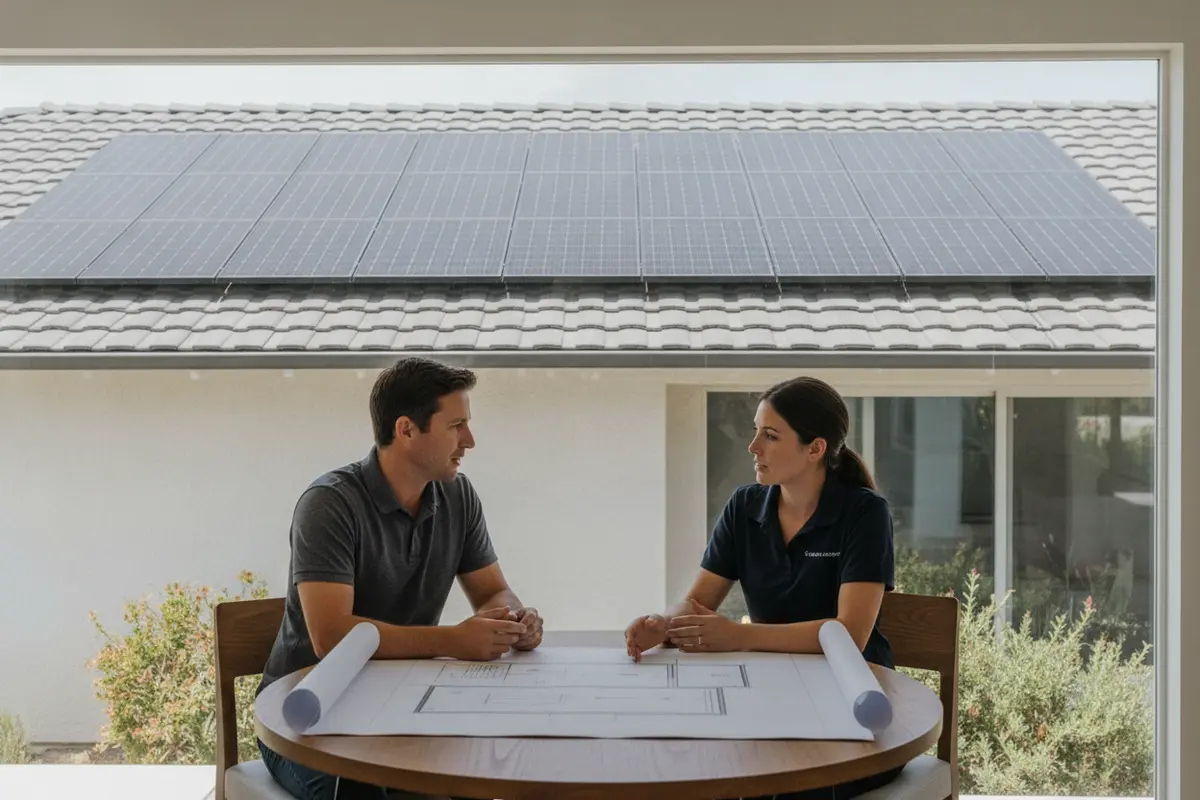
Shade and roof geometry also affect placement. A roof plane may look spacious from the street but include trees, chimneys, vents, or changes in slope that restrict usable panel locations. Ask to see the proposed layout and have the installer explain how the design accounts for those constraints. If you are considering a solar roof product rather than conventional panels, ask how its design, roofing scope, and utility review differ.
What do local permits and inspections cover?
Solar projects commonly require review by a local building department and, depending on the work, electrical permits and inspections. The authority having jurisdiction, project design, and local process determine the precise requirements. Permitting and inspection should be treated as separate project milestones, not as a single approval.
During permit review, the local authority evaluates submitted plans under applicable requirements. The installer should explain who prepares and submits the documents, who responds to review comments, and whether any homeowner action is needed. A plan correction or request for additional information can affect the schedule, so ask how updates will be communicated rather than treating an early estimate as a guaranteed date.
Inspection generally takes place after relevant work is installed. It checks completed work against approved plans and applicable local requirements. Before work begins, ask who requests the inspection, who needs to be present, and how a correction is handled if the inspector identifies an issue. Keep copies of approved plans, inspection records, and final project documents with your home records.
How are inspection and utility interconnection different?
A local inspection and utility interconnection serve different purposes. The local authority inspects work under its permitting process. The electric utility reviews the system for connection to the grid and follows its own application and authorization steps. Passing inspection does not necessarily mean the utility has completed its review or authorized the system to operate.
Ask for a written sequence of milestones that identifies the responsible party for each step. It may include permit approval, installation, local inspection, correction work if needed, utility review, and permission to operate. The exact sequence and terminology vary. A useful project contact should be able to explain which steps have been completed and what remains outstanding.
For a plain-language overview of grid-connected systems, see AMECO’s guide to an on-grid solar system and its explanation of net metering. If the system includes storage, ask whether the battery is part of the same application or requires additional documentation or review.
Which project stages should you compare?
Use the table below to compare what each proposal says about responsibilities and decisions. It is not a promise that every California jurisdiction follows an identical sequence; it is a checklist for spotting gaps and asking useful follow-up questions.
| Stage | What it addresses | Question to ask |
|---|---|---|
| Site and roof review | Roof condition, layout, shade, and electrical context | What has been verified, and what remains an assumption? |
| System design | Panel placement, equipment, and any battery configuration | How does the design reflect this home’s usage and roof constraints? |
| Local permit review | Plans and documents required by the local authority | Who submits plans and responds to correction requests? |
| Installation | Work described in the approved design and written scope | What work is included, excluded, or dependent on site conditions? |
| Local inspection | Review of completed work under local requirements | Who schedules inspection and manages any corrections? |
| Utility interconnection | Utility review and grid-connection authorization | What approval is needed before operation? |
Should a battery be part of the plan?
A battery stores some solar electricity for later use. Whether it belongs in a project depends on household priorities, usage patterns, utility arrangements, equipment choices, and budget. It may also provide backup for selected loads during an outage if the system is configured for that purpose. Solar panels alone generally do not keep a grid-connected home powered during an outage because systems commonly shut down for grid safety.
Start by listing the circuits or devices you would want to support during an outage. A battery designed for selected backup loads is not automatically the same as whole-home backup. Ask which circuits are connected, what operating assumptions the design uses, and whether the proposal describes limits on power and duration. The answer depends on the battery, loads, starting conditions, and how much stored energy is available.
Compare solar-only and solar-plus-battery proposals as distinct configurations. Ask whether the battery changes the system layout, equipment, permit package, utility application, or commissioning steps. Do not assume a battery is required or that it will meet every backup expectation. AMECO’s California solar battery guide and battery backup information provide further context.
How can you compare project proposals fairly?
Begin with consistent information: the same service address, recent electricity use, and any known plans that could change demand, such as an electric vehicle or major appliance. Then compare the complete scope rather than focusing only on panel count or a single production estimate. Two similarly sized systems can differ in equipment, layout, roof work, battery configuration, utility assumptions, and the work included.
Use this checklist to make differences visible:
- Does each proposal use the correct address, utility, and household usage information?
- Are roof condition, shading, layout, and any unresolved site questions explained?
- Does the proposal identify equipment and state whether storage or backup circuits are included?
- Are permit, inspection, and utility application responsibilities assigned?
- Are exclusions, assumptions, and possible change conditions described in writing?
- Does the production estimate explain its design assumptions instead of appearing as a guaranteed result?
- Are monitoring, system handoff, and support expectations described?
Look for differences that affect the whole project, not just the hardware list. One proposal may include roof coordination while another assumes the roof is ready. One may explain who follows up with the utility, while another leaves that responsibility unclear. AMECO’s project approach describes consultation, design, installation, and support. You can also review examples of completed projects to see different property and system contexts, while remembering that another property’s design does not establish what is right for yours.
What information should you prepare before requesting a plan?
A little preparation can make an initial discussion more useful. Gather recent electricity bills, note the utility listed on them, and write down any expected changes in household use. If you know the roof’s approximate age, past repairs, or planned replacement, include that information. You can also note which rooms or appliances matter most during an outage.
Photos of the roof and electrical panel may help start a conversation, but they do not replace a site-specific review. Avoid guessing at technical details you do not know. Instead, list the questions you want answered: whether the roof needs work, how the design handles shade, which utility process applies, and what approvals remain before operation.
For an initial planning tool, visit AMECO’s solar project calculator or review its residential solar information. If roof work may be part of the project, the solar and roofing coordination guide can help frame the discussion. A calculator can support early exploration, but a project-specific review is needed to evaluate the roof, utility process, and design assumptions together.
Schedule a conversation about your project
What is a practical next step for California homeowners?
Confirm the utility serving the property, understand the roof’s condition, and decide whether backup power is a priority. Then compare proposals that explain local approvals, interconnection responsibilities, design assumptions, and included work in writing. AMECO Solar & Roofing has operated in California since 1974 and provides solar and roofing services under one company. A project-specific conversation can help translate those considerations into a plan for your home; you can request a consultation.
What questions do homeowners ask about solar panel installation in California?
Does a California solar project need a permit?
Rooftop solar projects commonly require local permitting and inspection, but the exact requirements depend on the jurisdiction and project details. Ask the installer to confirm the process for your service address.
Can solar panels power my home during a blackout?
Grid-connected solar systems commonly shut down during an outage unless they are designed with suitable backup equipment. Ask whether a battery and backup circuits are included and which loads the system is intended to support.
Can the system operate as soon as installation is complete?
Not necessarily. Local inspection and utility interconnection steps may remain. Confirm which approvals are required and who will track them before the system is authorized to operate.
Should I replace my roof before installing panels?
That depends on the roof’s condition, material, and expected remaining service life. A roof assessment can help determine whether repair or replacement should be coordinated with the solar project.
Does every California utility use the same process?
No. Utility procedures and local permitting requirements can vary. Confirm the utility serving the property and ask the project team to explain the steps that apply at that address.
Taking time to clarify these details can make proposals easier to compare and help you understand the milestones between design and system operation.


